


Padding Can't Stop Rotation: Why Neck Strength Matters for Concussion Risk
On this page
Key takeaways
- Helmet padding and Guardian Caps soften contact on the outside of the head. They can't do much about how fast the head whips or turns after a hit.
- Researchers link rotational acceleration to the shearing strain associated with concussion, and the neck is what controls how the head moves after contact.
- Stronger necks are associated with lower concussion risk and less head motion, and training reliably builds neck strength. No study has yet proven that a neck training program prevents concussions.
- For coaches: train every direction including rotation, add reactive work, measure it, and make it routine.
Guardian Caps and helmet padding are only half the equation
The padded shell on top of a helmet has become one of football's most visible safety symbols. In October 2026, concussion researcher Chris Nowinski questioned how much it actually does, telling Pablo Torre that "more padding is not the answer." His point: adding size and weight to the helmet can help with some hits but make rotation worse on others, and the Guardian Caps most high school players wear are a weaker version than the NFL's.
Whatever you think of the caps, his underlying point is worth taking seriously. Padding works on the outside of the head. Much of the problem happens inside it, and the part of the body that controls how the head moves after a hit is the neck.
How concussions happen: linear vs. rotational acceleration
Your brain sits in fluid inside the skull. When the head is hit, the brain doesn't stop when the skull stops. It keeps moving, and that motion strains brain tissue.
That motion comes in two forms:
- Linear acceleration: the head moves in a straight line, like a nod or a snap backward.
- Rotational acceleration: the head twists or spins around the neck. Researchers link rotation to the shearing strain associated with concussion and more serious brain injury.
A helmet and padding spread out and soften the force at the point of contact. They can't do much about how fast the whole head whips or turns afterward. A larger, heavier helmet can even give a hit more leverage to twist the head.
Why neck strength matters after a hit
The neck is the only thing connecting a 10 to 12 lb head to the rest of the body. When its muscles are strong and switched on, the head and torso behave more like one solid unit. The same hit then has more mass to move, so the head accelerates less.
Think of it as protection from the inside out. Padding changes what hits the head. A strong, ready neck changes how the head responds.
Two things matter:
- Neck strength: how much force the neck muscles can produce in every direction, including rotation.
- Readiness: how quickly those muscles fire. Bracing before contact helps, but many of the worst hits are the ones a player never sees coming.
This is also why youth athletes and female athletes are a focus. On average they have less neck strength relative to head size, so there is more room to improve.
Neck strength and concussion risk: what the research says, and what it doesn't
The science on neck strength is promising but not settled. We'd rather you hear that from us than oversell it.
| Study | What it found |
|---|---|
|
Collins et al., 2014 6,704 high school athletes, 51 schools |
Athletes with weaker necks were more likely to be concussed. Each 1 lb gain in neck strength was associated with about 5% lower odds of concussion. |
|
Eckner et al., 2014 Lab study, athletes of many ages |
Stronger necks and bracing before impact both reduced how much the head moved after a load, in every direction including rotation. |
|
Ivanic et al., 2024 BJSM meta-analysis |
Resistance training clearly increases neck strength. Whether that lowers concussion rates hasn't been directly tested yet. |
|
Blyth et al., 2025 Soccer heading review, 60 studies |
Neck strength sometimes reduced head acceleration. Traditional strength work alone didn't, but adding neuromuscular (reactive) training did. |
|
Fownes-Walpole et al., 2025 BJSM review and expert consensus |
Evidence is mixed. Experts agreed on best practices for programming neck training in collision sports. |
The honest summary: stronger necks are associated with lower concussion risk and less head motion, and training reliably builds neck strength. No study has yet proven that a neck training program prevents concussions. Training that includes reactive, multi-directional work looks more effective than slow isolated reps.
For more of the studies behind neck training, see the Iron Neck research library.
Neck training for football and collision sports: 5 principles for coaches and parents
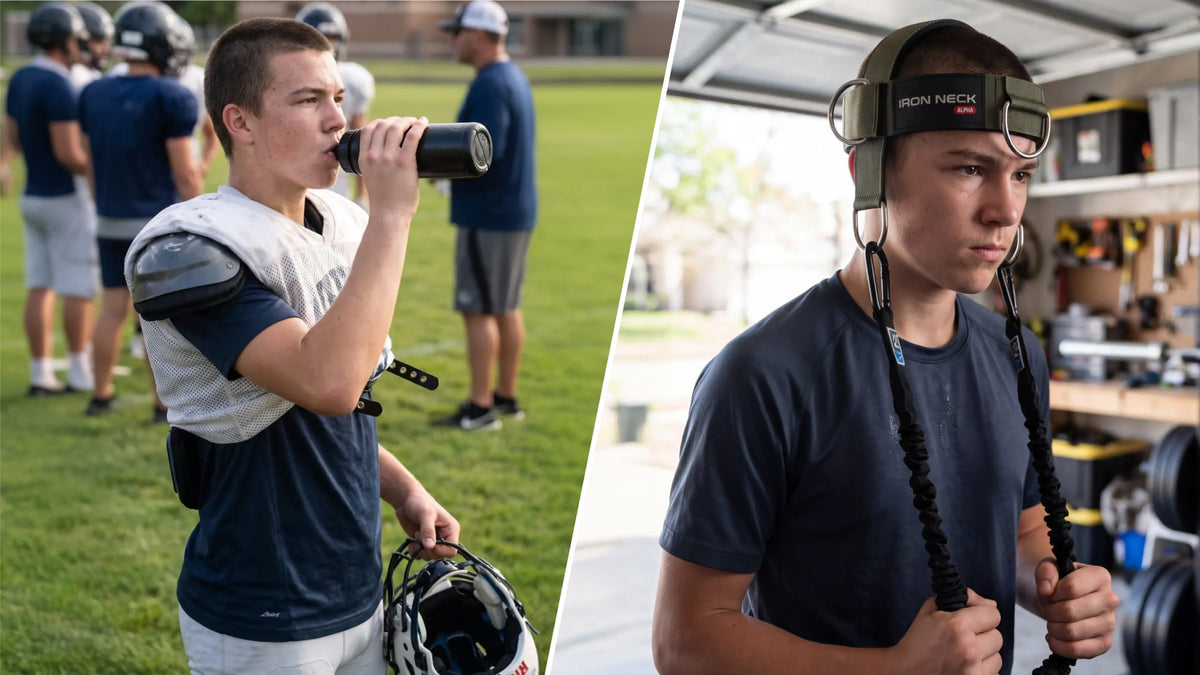
Neck training is cheap, low risk, and easy to add to a program athletes already run. A few principles from the research:
- Train every direction. Flexion, extension, side bending, and rotation. Rotation is the one most programs skip.
- Add reactive work. Once athletes have a base, include drills that make the neck respond to unpredictable forces, not just slow controlled reps.
- Measure it. A simple preseason and midseason neck strength check shows who's weakest and whether the program is working.
- Make it routine. Two or three short sessions a week, built into warm-ups or lifts, beat an occasional long one. Consistency is where programs usually fail.
- Start younger athletes light. Focus on control and technique first, then add load gradually.
Neck training is one layer of protection. It works alongside good tackling technique, rule enforcement, proper equipment fit, and taking every suspected concussion seriously.
The bottom line
No helmet, cap, or training tool makes a collision sport safe. But if the real problem is how the head moves after a hit, the neck deserves a place in the conversation. It's the one piece of protective equipment every athlete already has, and it can be trained.
Frequently asked questions
Are Guardian Caps enough to protect against concussion?
No helmet, cap, or training tool makes a collision sport safe. Padding spreads out and softens the force at the point of contact, but it can't do much about how fast the whole head whips or turns afterward, which is the motion researchers link to concussion.
Can neck strengthening prevent concussions?
No study has yet proven that a neck training program prevents concussions. Stronger necks are associated with lower concussion risk and less head motion after impact, and resistance training reliably builds neck strength.
What is rotational acceleration?
Rotational acceleration is when the head twists or spins around the neck after a hit. Researchers link it to the shearing strain associated with concussion and more serious brain injury.
How often should athletes train their neck?
Two or three short sessions a week, built into warm-ups or lifts, beat an occasional long one. Start younger athletes light and focus on control and technique before adding load.
Which neck exercises matter most?
Train every direction: flexion, extension, side bending, and rotation. Rotation is the one most programs skip. Once athletes have a base, add reactive drills that make the neck respond to unpredictable forces.
Iron Neck is a neck training system. It is not a medical device and is not intended to prevent, diagnose, or treat concussion or any other injury. Talk to a qualified medical professional about concussion risk and recovery.
Sources
- Chris Nowinski tells Pablo Torre NFL guardian caps are a 'scam', Awful Announcing / Yahoo Sports, Oct 2026
- Collins et al., Neck Strength: A Protective Factor Reducing Risk for Concussion in High School Sports, J Prim Prev, 2014
- Eckner et al., Effect of Neck Muscle Strength and Anticipatory Cervical Muscle Activation on the Kinematic Response of the Head to Impulsive Loads, Am J Sports Med, 2014
- Ivanic et al., Efficacy of exercise interventions on prevention of sport-related concussion, Br J Sports Med, 2024
- Blyth et al., What Factors Influence Head Acceleration During a Purposeful Header in Soccer Players?, Sports Med, 2025
- Fownes-Walpole et al., Combining evidence and practice to optimise neck training, Br J Sports Med, 2025