



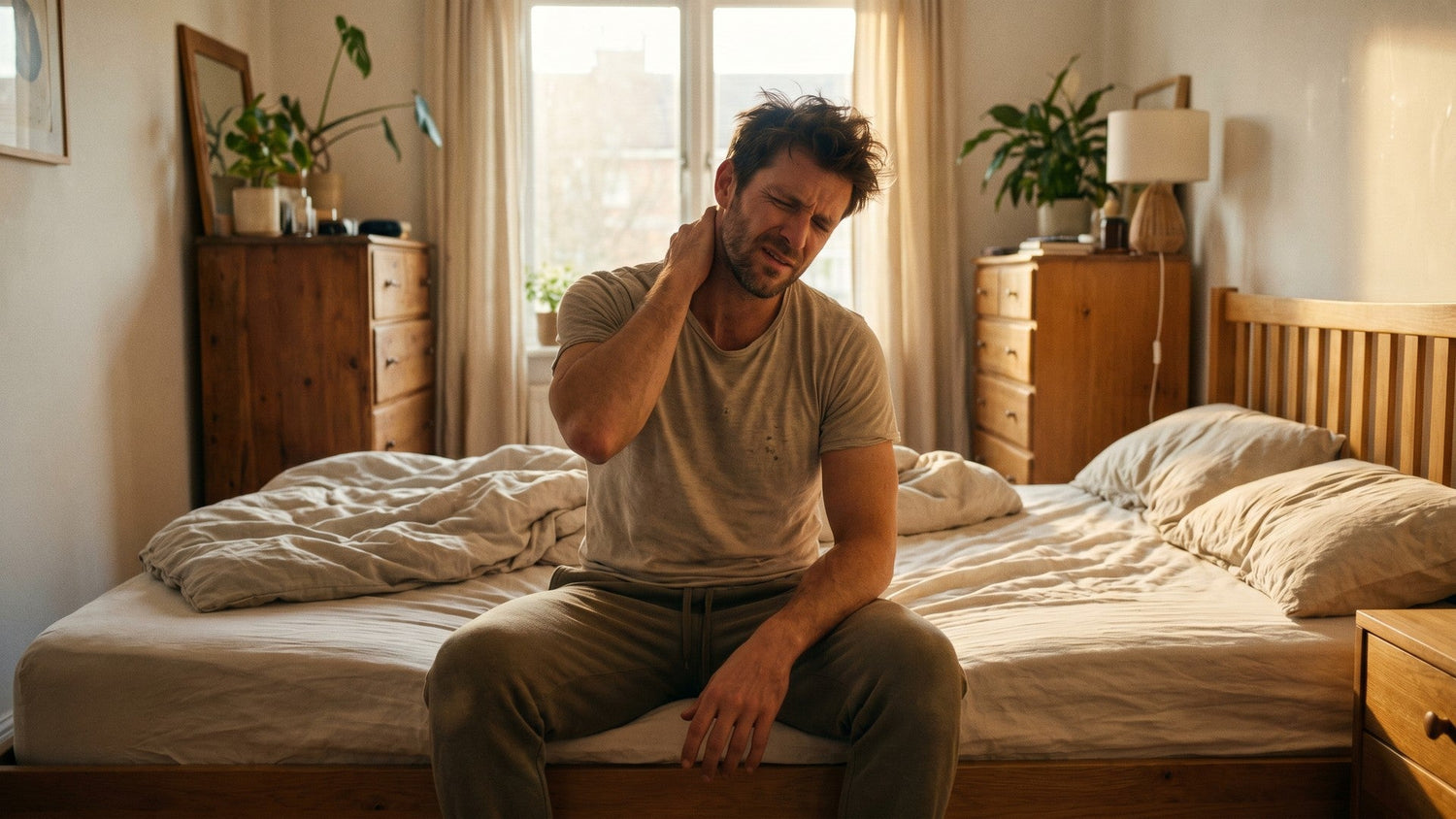
Most people have been there, you fall asleep fine and wake up unable to turn your head without wincing. It throws off your whole morning before it has even started. The good news is that for most people, a stiff neck after sleeping is a muscle problem, and muscle problems are fixable. This guide covers why it happens, how to loosen it up, and what you can do so it stops being a recurring thing.
Why Does Your Neck Get Stiff Overnight?
Your neck is doing a quiet job all night, holding your head in whatever position you sleep in for six to eight hours straight. When that position is even slightly off, the muscles accumulate strain with no opportunity to shift and reset. Here is what usually drives it.
Sleeping in a Strained Position
If your head tilts too far forward, backward, or to one side while you sleep, the surrounding muscles stay under load the entire time. There is no movement to release that tension the way there is when you are awake. You wake up with stiffness that is the direct result of hours of sustained strain in a suboptimal position.
Stomach sleeping is the worst offender. It keeps your neck rotated to one side for the entire night and is the single most common position-related cause of morning stiffness. If you are a stomach sleeper and waking up stiff is a regular thing for you, that is the first thing to change.
Using the Wrong Pillow
Pillow height, firmness, and shape all affect how your cervical spine sits overnight. A pillow that is too high pushes the head forward. Too flat, and the head drops to the side. Neither position lets the neck recover, they just trade one strain pattern for another.
According to Cleveland Clinic guidance on pillow selection, the right pillow depends heavily on your sleeping position. What works for a side sleeper actively misaligns a back sleeper.
| Sleep Position | What to Look For | Why |
|---|---|---|
| Back sleeper | Low to medium loft, contoured or cervical roll | Maintains the natural cervical curve without pushing the head forward |
| Side sleeper | Medium to high loft, firm enough to fill the head-to-shoulder gap | Keeps the cervical spine level — most people underestimate how wide this gap is |
| Stomach sleeper | Very thin or no pillow but ideally switch positions | Stomach sleeping rotates and extends the neck for the entire duration of sleep |
Jaw Clenching During Sleep
Bruxism, grinding or clenching your jaw at night creates tension that travels directly into the neck and upper shoulders. If you regularly wake up with jaw soreness alongside neck stiffness, or if stress has been high lately, this is worth noting. It is a common driver that often gets overlooked because it has no obvious postural cause.
Sudden Movements While Sleeping
Rolling over sharply, reacting to a dream, or sitting up quickly can pull a cervical muscle or irritate a joint especially if those muscles are already carrying some fatigue from the day. It is more common during periods of poor sleep quality or high stress, when sleep is lighter and more disruptive.
What You Did During the Day Carries Over
Your neck does not start each night at zero. Hours of desk work, driving, or phone use build up tension and postural load that your neck carries into sleep. If that baseline tension is already high, even a reasonably good sleep position can tip it into stiffness by morning.
Addressing how to fix bad neck posture during the day directly reduces what your neck has to deal with overnight.
Old Injuries Showing Up Overnight
A past whiplash or sports injury that seemed to resolve can resurface as morning stiffness, particularly when the underlying muscle weakness was never fully addressed. The static load of sleep exposes what daily movement masks. If this sounds familiar, targeted strengthening is the long-term answer, not just managing the symptoms each morning.
Underlying Conditions
Conditions like cervical disc degeneration, arthritis, or nerve compression can make overnight stiffness a recurring pattern rather than an occasional one. If your stiffness is persistent, worsening, or accompanied by other symptoms, get it assessed by a professional rather than trying to manage it on your own.
How to Loosen It Up
These approaches are appropriate for typical muscular stiffness with no red flag symptoms. If anything in the section below applies to you, see a professional first.
Heat and Cold
Research supports a staged approach (Childress & Stuek, 2020). In the first 24–48 hours, cold reduces inflammation and numbs acute discomfort, use an ice pack wrapped in a cloth for 10–15 minutes. From day 2 onward, heat is more effective: it relaxes muscle tissue and improves circulation. A warm shower or heat pack for 15–20 minutes works well. Avoid heat in the first 24–48 hours if swelling is present.
Gentle Movement
Evidence supports early gentle movement for recovery from muscular neck stiffness (Blanpied et al., 2017). The goal is slow, controlled movement within a comfortable range not forced stretching, not end-range holds. The image below shows two appropriate movement patterns: front-to-back nodding and chin-to-shoulder rotation.
Move slowly. Work within a comfortable range. Stop immediately if you feel dizziness, numbness, tingling, or any weakness in your arms.
Once the acute stiffness has resolved, the neck curl exercise is a solid next step, it targets the deep cervical flexors that overnight positioning consistently underloads.
OTC Pain Relief
Over-the-counter anti-inflammatories such as ibuprofen or naproxen can help manage acute discomfort in the short term (Childress & Stuek, 2020). Consult your pharmacist or GP for guidance on what is appropriate for you, particularly if you take other medications or have any relevant health conditions.
What to expect: Most cases of muscular morning neck stiffness resolve within 3–5 days with heat, gentle movement, and sleep setup corrections. If things are not improving after 2–3 weeks, or if symptoms are getting worse, see a healthcare professional.
When It Might Be More Than Muscle Stiffness
Most morning stiffness is muscular and clears up in a few days. The table below covers signs that something else may be going on. This is not a diagnostic tool, if you are unsure about your symptoms, see a professional.
| Symptom alongside neck stiffness | What it may suggest | What to do |
|---|---|---|
| Numbness, tingling, or weakness in the arm or hand | Possible nerve involvement | See a doctor — do not self-manage |
| Fever and sensitivity to light | Possible meningitis | Go to emergency care immediately |
| Dizziness or visual changes when moving the neck | Possible cervical artery dissection | Go to emergency care immediately |
| Sudden severe headache at the base of the skull | Possible vascular event | Go to emergency care immediately |
| Stiffness following a fall, impact, or collision | Possible structural injury | Seek assessment before any movement or exercise |
| No improvement after 7 days of self-management | May need further investigation | See a healthcare professional |
This table is for general orientation only and is not a diagnostic tool.
How to Stop It Coming Back
Dealing with morning stiffness once is annoying. Dealing with it every week means something in your routine needs changing.
Sort Your Sleep Setup
The pillow table earlier in this article is the starting point. The single biggest change most people can make is matching their pillow to their actual sleep position and body proportions. If you are a stomach sleeper, switching to side or back sleeping is the most impactful long-term intervention, no pillow fully compensates for hours of cervical rotation.
Fix Your Daytime Posture
What happens at your desk, in your car, or on your phone during the day sets the baseline tension your neck carries into sleep. Long hours in a forward head position mean the muscles arrive at bedtime already loaded. Our guide on how to fix bad neck posture covers the practical corrections.
Cold weather is also worth knowing about, cold temperatures tighten the cervical muscles and reduce local circulation, making them more reactive to overnight strain. If your stiffness is worse in winter, our guide on cold weather and neck discomfort covers why and what to do about it.
Build Neck Resilience
The most durable fix is building a neck that handles the positional demands of sleep without accumulating strain. Research supports cervical strengthening as an effective long-term strategy for reducing recurring neck discomfort (Blanpied et al., 2017). Training flexion, extension, lateral flexion, and rotation across a comfortable range builds the muscular endurance that makes morning stiffness progressively less frequent.
For a realistic sense of what to expect and over what timeframe, see our overview of neck training results and what to expect.
Frequently Asked Questions
Why does my neck hurt only after sleeping but feel fine during the day?
The neck stays in one position for hours during sleep, and if that position is even slightly off, the muscles accumulate strain that shows up as stiffness on waking. Once you are up and moving, circulation improves and the muscles loosen. The underlying cause - the sleep setup remains unchanged until you address it.
What is the best sleeping position for neck health?
Back or side sleeping with an appropriately supportive pillow. Back sleeping works well with a low to medium loft pillow. Side sleeping requires a firmer, higher pillow to fill the gap between the head and shoulder. Stomach sleeping consistently produces the worst outcomes for morning neck stiffness and is best avoided if it is a recurring problem for you.
How long should I try home remedies before seeing a doctor?
If stiffness has not improved after 3–5 days of heat, gentle movement, and sleep setup adjustments or if it is getting worse see a healthcare professional. Seek immediate assessment if you have numbness, arm weakness, dizziness, or any of the red flags listed in the table above (Childress & Stuek, 2020).
Can stress cause neck stiffness overnight?
Yes. Stress drives muscular tension in the neck and shoulders, and jaw clenching during sleep is a common stress-related contributor. A consistent wind-down routine before bed, limiting screens, managing stress, avoiding stimulants late in the day, helps reduce this pattern.
Is it safe to train when my neck is stiff?
Gentle mobility work is appropriate for typical muscular morning stiffness. Stay in a comfortable mid-range, move slowly, and stop at any warning sign. Avoid heavy loading and fast movements until the acute stiffness has fully resolved. If any red flag symptoms are present, get medical clearance before exercising (Blanpied et al., 2017).
When is morning neck stiffness an emergency?
If neck stiffness comes with sudden severe headache, dizziness, visual changes, slurred speech, or arm weakness, seek emergency care immediately. Neck stiffness alongside fever and light sensitivity is a potential meningitis warning sign requiring the same urgent response. Do not attempt home treatment for either presentation (Yaghi et al., 2024).
References
- Blanpied PR, Gross AR, Elliott JM, et al. Neck pain: clinical practice guidelines — revision 2017. J Orthop Sports Phys Ther. 2017;47(7):A1–A83. https://pubmed.ncbi.nlm.nih.gov/28637660/
- Childress MA, Stuek SJ. Neck pain: initial evaluation and management. Am Fam Physician. 2020;102(3):150–156. https://pubmed.ncbi.nlm.nih.gov/32786213/
- Yaghi S, Jadhav AP, Engelter S, et al. Treatment and outcomes of cervical artery dissection in adults: a scientific statement from the AHA/ASA. Stroke. 2024;55(3):e91–e106. https://www.ahajournals.org/doi/10.1161/STR.0000000000000436
- ACR Appropriateness Criteria®. Cervical pain or cervical radiculopathy: 2024 update. J Am Coll Radiol. 2025;22(5S):S136–S162. https://www.jacr.org/article/S1546-1440(24)00833-5/fulltext
Disclaimer: The Iron Neck blog provides educational content on neck training, fitness, and recovery. It is not a substitute for medical advice. Please consult a healthcare professional before starting any new exercise or recovery programme.
Iron Neck is the only device that trains your neck through 360 degrees of resistance, combining rotation, extension, and lateral movement in one tool. Used by NFL teams, UFC fighters, and physical therapists.


Leave a comment
This site is protected by hCaptcha and the hCaptcha Privacy Policy and Terms of Service apply.