



Governance and Policy Foundations for Football Safety: NFHS, NCAA, and State Compliance
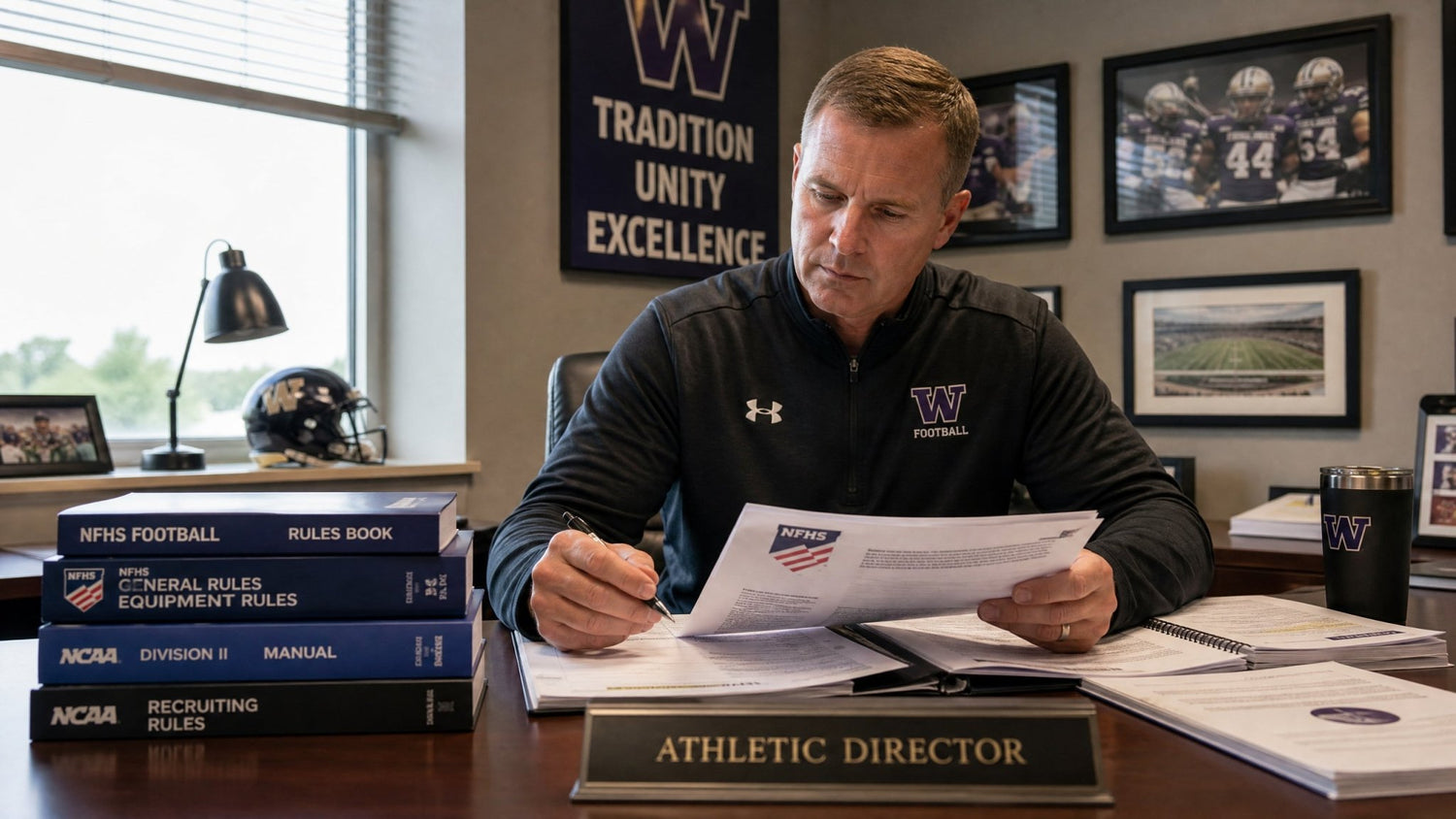
Football player safety is governed by a layered framework of national rules, state laws, and institutional policies. Understanding this framework is essential for athletic directors, head coaches, and athletic trainers who are responsible for building and maintaining compliant, effective safety programs.
This article maps the governance landscape for football safety, identifies the key regulatory bodies and their requirements, and explains how programs can build policies that meet and exceed the minimum standards.
The Governance Hierarchy
Football safety governance operates at four levels, each building on the one below:
- Federal law — limited direct regulation of sports safety, but relevant in areas like Title IX and the Americans with Disabilities Act
- State law — concussion laws, heat safety requirements, and athletic trainer practice acts vary significantly by state
- National governing body rules — NFHS (high school) and NCAA (collegiate) set rules that member programs must follow
- Institutional policy — individual schools and programs set policies that must comply with all higher levels but can be more restrictive
Compliance requires understanding all four levels. A program that complies with NCAA rules but violates state law is not compliant. A program that complies with state law but has inadequate institutional policies may still face liability when injuries occur.
NFHS: The High School Framework
The National Federation of State High School Associations (NFHS) sets playing rules and sports medicine guidelines for high school athletics. Key NFHS safety requirements for football include:
Concussion Management
The NFHS Sports Medicine Advisory Committee (SMAC) publishes concussion management guidelines that serve as the baseline for most state high school athletic association policies. The core requirements: removal from play for suspected concussion, no same-day return, and written medical clearance before return to play.
Heat Acclimatization
The NFHS publishes heat acclimatization guidelines that specify the progression from helmets-only to full equipment during the preseason. Most state athletic associations have adopted these guidelines or a more restrictive version.
Equipment Standards
NFHS rules require that all helmets meet NOCSAE standards. Rules on mouthguards, face masks, and other equipment are specified in the annual NFHS Football Rules Book.
NCAA: The Collegiate Framework
The NCAA's Sport Science Institute (SSI) publishes comprehensive health and safety guidelines for collegiate athletics. Key NCAA requirements for football include:
Concussion Protocol
NCAA member institutions must have a concussion management plan that includes: pre-participation baseline testing, removal from play for suspected concussion, same-day return prohibition, and return-to-play clearance by a physician or physician designee. The plan must be reviewed annually and signed by the team physician and athletics director.
Contact Limitations
NCAA rules limit full-contact practice to 75 minutes per week during the regular season. Preseason contact limitations are specified in the annual NCAA Football Rules and Interpretations.
Sickle Cell Trait
NCAA Division I requires sickle cell trait screening for all student-athletes or a waiver signed by the athlete acknowledging the risks of declining screening.
Heat Safety
The NCAA SSI publishes heat acclimatization guidelines that are mandatory for Division I programs and recommended for Divisions II and III.
State Concussion Laws
All 50 states have passed youth concussion laws. The Korey Stringer Institute at the University of Connecticut publishes an annual ranking of state high school athletic association concussion policies. The ranking evaluates policies on seven criteria:
- Removal from play
- Medical clearance requirement
- Return-to-play protocol
- Annual athlete education
- Annual parent education
- Annual coach education
- Return-to-learn protocol
States that meet all seven criteria receive the highest ranking. As of 2026, approximately 30 states meet all seven criteria. Programs in states with lower-ranked policies should consider adopting the higher standards voluntarily — both for athlete protection and to reduce liability exposure.
Program-Level Policy Documentation
Compliance with external requirements is necessary but not sufficient. Programs also need internal policies that translate external requirements into operational procedures. Key policy documents include:
- Concussion management protocol — the step-by-step procedure for managing a suspected concussion from sideline assessment through return to play
- Emergency action plans — venue-specific plans for each location where the team practices or competes
- Heat safety protocol — WBGT monitoring procedures, activity modification thresholds, and heat illness response procedures
- Pre-participation examination policy — requirements for PPE completion, documentation, and clearance
- Supplement policy — requirements for third-party certification and disclosure of supplement use
- Weight management policy — prohibition on dehydration-based weight cutting and monitoring requirements
Liability Basics
Athletic programs face potential liability when athletes are injured. The legal standard is negligence: did the program fail to meet the standard of care that a reasonable program would have provided? Written policies that meet or exceed the standards established by NFHS, NCAA, and state law are the primary defense against negligence claims.
Key liability principles for football programs:
- Documentation matters — a policy that exists but is not documented is difficult to prove in litigation
- Compliance matters — a policy that exists but is not followed creates worse liability exposure than no policy at all (it demonstrates that the program knew the standard and failed to meet it)
- Supervision matters — inadequate supervision of athletes during practice and competition is one of the most common bases for negligence claims
- Qualified personnel matters — using unqualified personnel for medical decisions creates liability exposure
Programs should consult with legal counsel when developing safety policies, particularly in areas with significant liability exposure such as concussion management and emergency response.
Leave a comment
This site is protected by hCaptcha and the hCaptcha Privacy Policy and Terms of Service apply.