



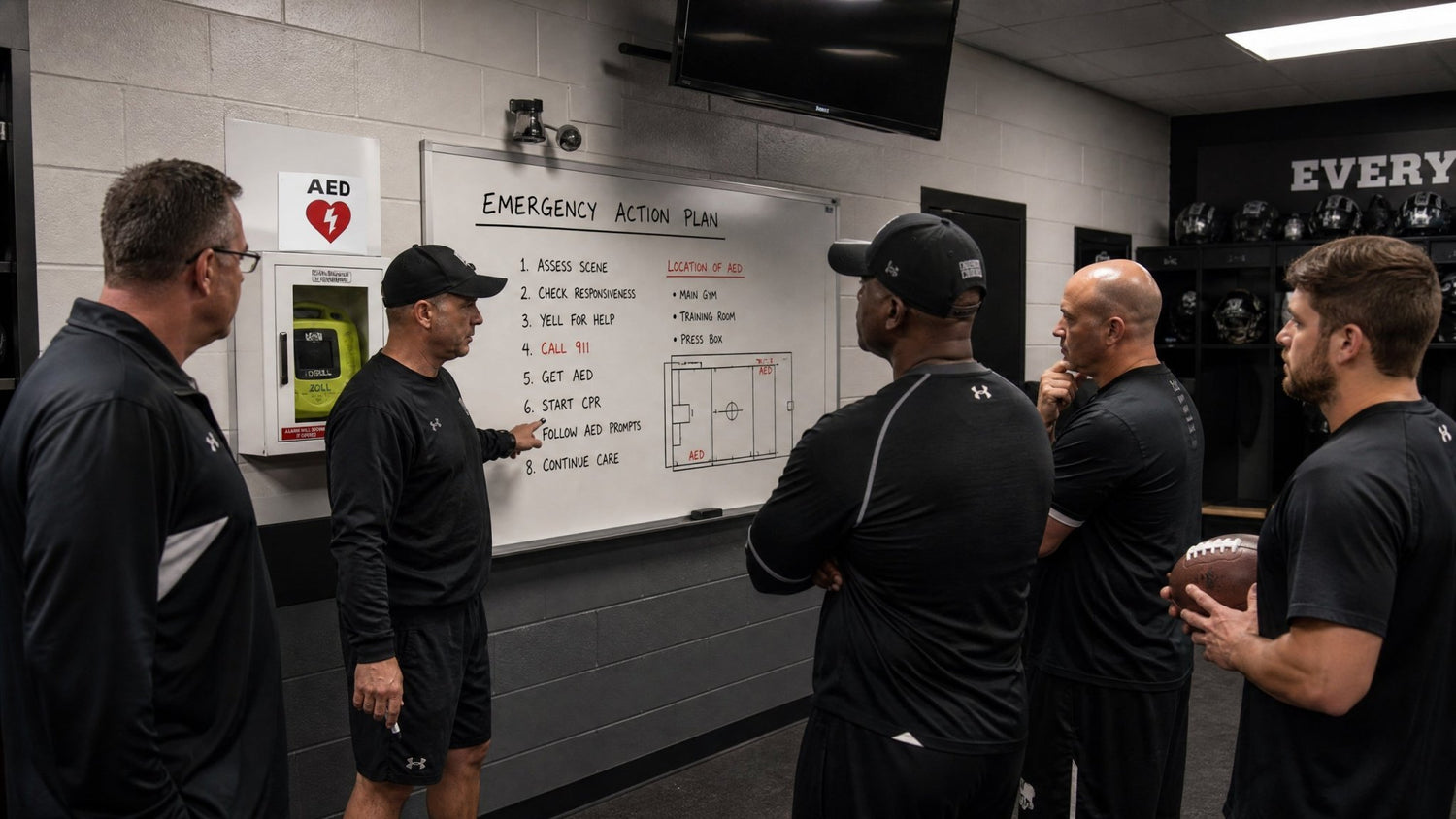
Emergency Action Plans for Football Programs: A Step-by-Step Guide
An Emergency Action Plan (EAP) is a written, rehearsed protocol that specifies exactly what happens when a medical emergency occurs at your facility. For football programs, having a well-designed EAP is not just best practice — it is a legal requirement in most states and a fundamental component of the standard of care.
This guide walks through the development of venue-specific EAPs for football programs, covering everything from AED placement to catastrophic spine injury response.
Why Venue-Specific EAPs Matter
A single generic EAP is not sufficient. Each venue where your team practices or competes presents different logistical challenges: different AED locations, different EMS access points, different communication systems, and different staff configurations. A player who collapses in the weight room needs a different response than a player who goes down on the practice field.
The National Athletic Trainers' Association (NATA) recommends venue-specific EAPs for every location where athletic activity occurs. At minimum, football programs need EAPs for:
- Primary practice field
- Game stadium
- Weight room / indoor training facility
- Away game venues (a template that can be adapted)
- Travel situations (bus, hotel)
The Five Components of an Effective EAP
1. Emergency Personnel
Identify who is responsible for each role in an emergency. The EAP should name specific individuals (by title, not just name, to survive staff turnover) and their responsibilities:
- First responder — the person who reaches the injured athlete first and initiates assessment
- Emergency caller — the person who calls 911 (designate a backup)
- AED retriever — the person who retrieves the AED and brings it to the scene
- EMS director — the person who meets EMS at the entrance and directs them to the scene
- Scene controller — the person who keeps other athletes and bystanders away from the scene
2. Emergency Communication
Specify the communication chain: who calls 911, what information to provide (location, nature of emergency, number of victims, access point), and how staff communicate with each other during the response. Cell phone coverage should be verified at each venue — dead zones require alternative communication plans.
3. Emergency Equipment
Document the location of all emergency equipment at each venue:
- AED (automated external defibrillator) — location, access code if locked
- Spine board and cervical collars
- Emergency medical kit
- Cold-water immersion tub (for heat stroke response)
- Oxygen (if available)
AED placement is critical. The American Heart Association recommends that AEDs be accessible within 3–5 minutes of any location in the facility. For large practice complexes, multiple AEDs may be necessary.
4. Emergency Facilities
Identify the nearest emergency medical facility, the preferred route for EMS access to each venue, and any access restrictions (locked gates, narrow passages) that EMS needs to know about in advance. Consider meeting with your local EMS provider annually to walk through your facilities and review your EAPs together.
5. Roles and Responsibilities
Every staff member who is present at practices and games should know their role in an emergency. This is not something that can be learned in the moment. Roles must be assigned, documented, and rehearsed.
Catastrophic Injury Response: Spine and Head Injuries
Spine injuries in football require specific protocols that differ from general emergency response. The key principles:
Suspected Cervical Spine Injury
- Do not move the athlete unless they are in immediate danger
- Maintain in-line cervical stabilization until EMS arrives
- Do not remove the helmet — it provides cervical stabilization and should only be removed by trained personnel using the two-person technique
- Remove the facemask to access the airway if needed (facemask cutters should be in the emergency kit)
- If the athlete is unresponsive and not breathing, begin CPR — airway access takes priority over spine precautions
Helmet and Shoulder Pad Removal
Current guidelines from the National Athletic Trainers' Association recommend leaving the helmet and shoulder pads in place during transport unless airway access is required. If removal is necessary, it must be performed by trained personnel using the two-person technique to maintain cervical alignment. All athletic trainers and team physicians should be trained in this procedure annually.
Rehearsal: The Most Important Step
An EAP that exists only on paper is not an EAP — it is a liability. The plan must be rehearsed at least once per year, ideally at the start of each season before the first practice.
Rehearsal should be realistic: walk through the actual response at the actual venue, with the actual staff who will be present. Time the response from the moment of simulated injury to AED deployment. The goal is less than 3 minutes for AED deployment in a cardiac emergency.
After each rehearsal, debrief: what worked, what didn't, what needs to change. Update the EAP accordingly.
Documentation and Review
EAPs should be reviewed and updated annually. Any time staff changes, venue configurations change, or equipment is relocated, the EAP must be updated. Keep a copy at each venue, in the athletic training room, and with the head coach.
After any actual emergency, conduct a formal after-action review. What happened, what the response looked like, what worked, and what needs improvement. This review should be documented and used to improve the EAP.

Leave a comment
This site is protected by hCaptcha and the hCaptcha Privacy Policy and Terms of Service apply.