

Strength & Longevity · Program 37

Runner Posture & Control

Every stride sends an impact pulse up the spine that the neck must quietly absorb, thousands of times per run. This program builds the postural endurance that keeps your head balanced over your shoulders when fatigue starts pulling it forward, which is exactly when form and pace fall apart. It is short, three focused sessions a week that slot easily around a running schedule.

Focus · RunnersFrequency · 3x per weekSession · 12-15 min
Runner Posture & Control cover art
The goal

Build the head control and postural endurance that keep running form tall from the first mile to the last.

Who it is for
  • Distance runners whose form collapses in the final miles
  • Marathoners and half-marathoners building durable posture
  • Recreational runners with post-run neck and upper-back tightness

Tall Running Base

Establish the stacked head position that efficient running flows from and build baseline strength around it. Everything here reinforces the tall, relaxed carriage coaches keep asking for.

01Muscles worked in Protraction / RetractionDemo video coming soon

Protraction / Retraction

3 sets of 10 repsFront & Back

A head that drifts forward adds effective weight to every stride, and this movement builds the strength to keep it stacked where running is cheapest.

How To
1Glide your head straight forward, reaching your chin outward, then glide it straight back as though making a double chin.
2Keep your eyes and chin level the entire time and move smoothly along a horizontal path.
Coaching Cues
Slide your head along an invisible shelf
Make a double chin
then get rid of it
No nodding
keep your eyes level throughout
Think forward and back
not up and down
Muscles Activated
SCMAnterior scaleneDeep neck flexorsSemispinalis cervicis
02Muscles worked in Isometric HoldDemo video coming soon

Isometric Hold

3 sets of 15 second holds each directionFront

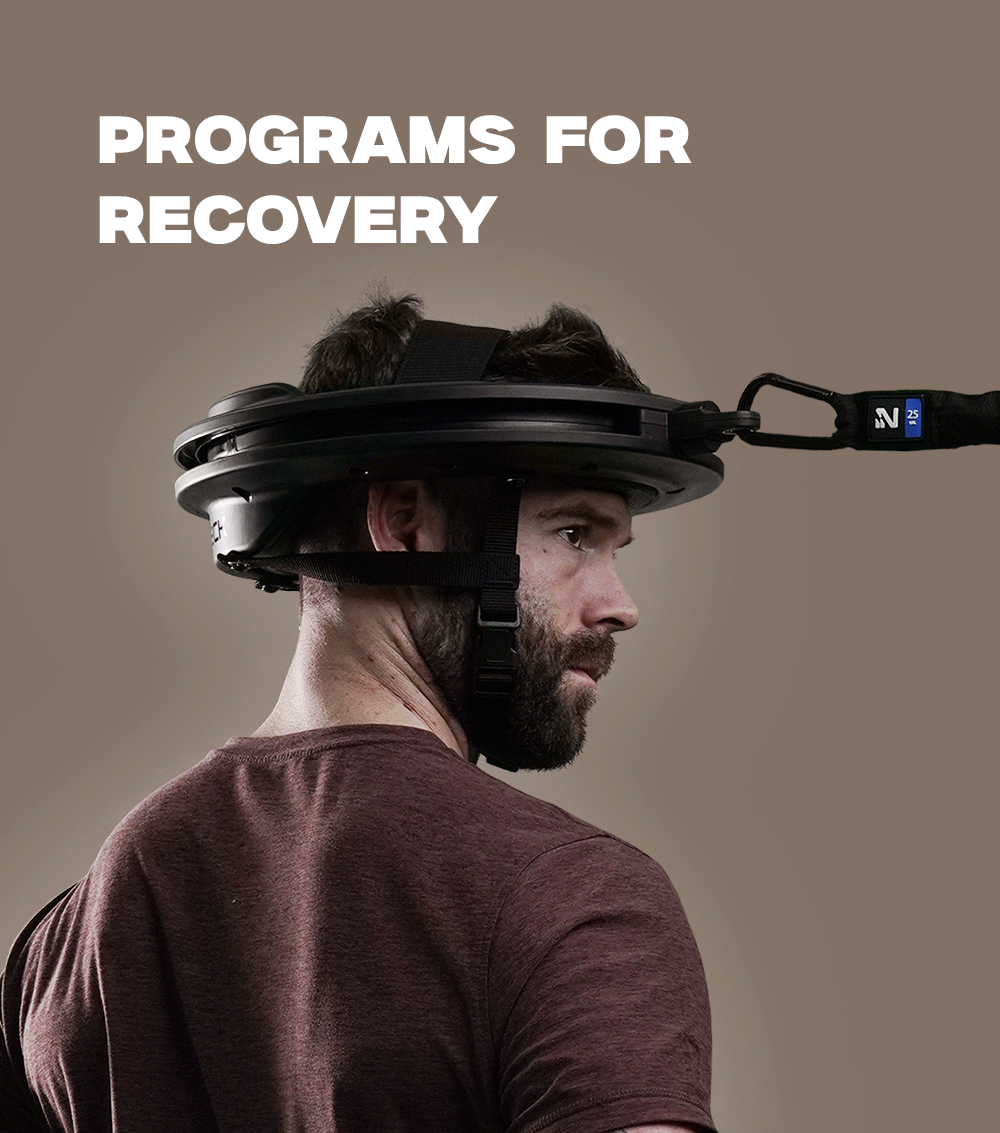
Braced holds train the quiet, constant stabilization that absorbs footstrike impact mile after mile.

How To
1Set your head in the working position and hold it there against the band.
2Keep your chin level, breathe normally, and resist any drift for the full time prescribed.
Coaching Cues
Brace your neck without clenching your jaw
Keep breathing through the hold
Nothing moves but your ribs
End the set when your position starts to drift
Muscles Activated
Deep neck flexors/extensorsSCMSplenius
03Muscles worked in 360 SpinDemo video coming soon

360 Spin

3 sets of 4 rotations each directionFront

A stable head over a moving body is the essence of running form, and the spin trains that dissociation directly.

How To
1Stand tall with your shoulders stacked over your hips and fix your eyes on a point straight ahead.
2Rotate your body in place, hips, torso and feet, while your head stays completely still.
3Move slowly through a full clockwise turn, then reverse and complete a full counterclockwise turn.
Coaching Cues
Head still
body turns
Move like a tank turret with your upper body rotating under a fixed head
Do not let your nose drift from its anchor point
Feel the resistance wrap around you as you rotate
Muscles Activated
SCMSplenius capitis/cervicisSemispinalis capitisMultifidus
04

Look Left, Look Right

3 sets of 8 reps each sideAny direction

Checking for traffic mid-stride should not disturb your gait, and rotational strength keeps the glance from becoming a wobble.

How To
1Stand tall with your chest up and your chin level.
2Turn your head slowly to one side as far as you can go comfortably, hold for a moment, then return to center and repeat to the other side.
3Only your head moves.
Coaching Cues
Chin stays level as you rotate
Eyes lead the movement
Do not tilt your head
it is a turn and not a lean
Move with control and not momentum
Muscles Activated
SCMSplenius capitis/cervicisLongissimus capitis

Advance whenAdvance when the tall head position feels natural on easy runs without conscious correction.

Endurance That Outlasts the Run

Extend postural capacity past the length of your longest run. Slow tempos and flowing movement build the fatigue resistance that guards late-race form.

01Muscles worked in Protraction / RetractionDemo video coming soon

Protraction / Retraction (with hold)

3 sets of 15 second holdsFront & Back

Long retraction holds are a direct rehearsal of holding the chin level at mile 18 when everything wants to slump.

How To
1Glide your head straight forward, reaching your chin outward, then glide it straight back as though making a double chin.
2Keep your eyes and chin level the entire time and move smoothly along a horizontal path.
Coaching Cues
Slide your head along an invisible shelf
Make a double chin
then get rid of it
No nodding
keep your eyes level throughout
Think forward and back
not up and down
Muscles Activated
SCMAnterior scaleneDeep neck flexorsSemispinalis cervicis
02Muscles worked in 360 SpinDemo video coming soon

360 Spin (slow tempo)

3 sets of 4 slow rotations each directionFront

Slow continuous spins train endurance across every direction at once, matching the long steady-state nature of distance running.

How To
1Stand tall with your shoulders stacked over your hips and fix your eyes on a point straight ahead.
2Rotate your body in place, hips, torso and feet, while your head stays completely still.
3Move slowly through a full clockwise turn, then reverse and complete a full counterclockwise turn.
Coaching Cues
Head still
body turns
Move like a tank turret with your upper body rotating under a fixed head
Do not let your nose drift from its anchor point
Feel the resistance wrap around you as you rotate
Muscles Activated
SCMSplenius capitis/cervicisSemispinalis capitisMultifidus
03

Figure Eights

3 sets of 5 figure eights each directionFront or Back

Flowing figure eights loosen the neck and shoulders that runners habitually carry tension in, coordination and release in the same movement.

How To
1Draw a sideways figure eight in the air with your nose.
2Nod down and to one side, loop up and around in a smooth curve, cross the midline and continue into a mirrored curve on the other side.
3Keep the motion flowing, then repeat in the opposite direction.
Coaching Cues
Paint a sideways eight in the air with your nose
Let your head flow and not jerk
Stay loose in the shoulders and spine
Make it smooth and continuous like cursive writing
Muscles Activated
SCMSpleniusLongissimusDeep flexors/extensorsSuboccipitals
04

Look Left, Look Right (tempo)

3 sets of 8 reps each side, varied speedAny direction

Varying rotation speed trains control at both the easy glance and the sharp look, the full menu of head movement a run actually contains.

How To
1Stand tall with your chest up and your chin level.
2Turn your head slowly to one side as far as you can go comfortably, hold for a moment, then return to center and repeat to the other side.
3Only your head moves.
Coaching Cues
Chin stays level as you rotate
Eyes lead the movement
Do not tilt your head
it is a turn and not a lean
Move with control and not momentum
Muscles Activated
SCMSplenius capitis/cervicisLongissimus capitis

Advance whenAdvance when your head stays tall through your longest weekly run without late-run neck or trap tension.

Impact-Proof Form

Make posture automatic under fatigue and impact. Perturbation stands in for footstrike jostle, and precision work keeps the eyes level while everything moves.

01Muscles worked in Protraction / RetractionDemo video coming soon

Protraction / Retraction (with perturbation)

3 sets of 8 reps with perturbationFront & Back

Recovering alignment from small unexpected pulls is the same correction your neck makes at every footstrike, trained deliberately instead of by accident.

How To
1Glide your head straight forward, reaching your chin outward, then glide it straight back as though making a double chin.
2Keep your eyes and chin level the entire time and move smoothly along a horizontal path.
Coaching Cues
Slide your head along an invisible shelf
Make a double chin
then get rid of it
No nodding
keep your eyes level throughout
Think forward and back
not up and down
Muscles Activated
SCMAnterior scaleneDeep neck flexorsSemispinalis cervicis
02

Figure Eights (eye tracking)

3 sets of 4 figure eights with eye trackingFront or Back

Runners depend on a steady gaze over a bouncing body, and coordinating eyes with neck movement trains exactly that stability.

How To
1Draw a sideways figure eight in the air with your nose.
2Nod down and to one side, loop up and around in a smooth curve, cross the midline and continue into a mirrored curve on the other side.
3Keep the motion flowing, then repeat in the opposite direction.
Coaching Cues
Paint a sideways eight in the air with your nose
Let your head flow and not jerk
Stay loose in the shoulders and spine
Make it smooth and continuous like cursive writing
Muscles Activated
SCMSpleniusLongissimusDeep flexors/extensorsSuboccipitals
03Muscles worked in 360 SpinDemo video coming soon

360 Spin (quarter pauses)

3 sets of 3 rotations with quarter pausesFront

Paused rotations add a strength ceiling that makes the endurance below it more durable when a race gets long.

How To
1Stand tall with your shoulders stacked over your hips and fix your eyes on a point straight ahead.
2Rotate your body in place, hips, torso and feet, while your head stays completely still.
3Move slowly through a full clockwise turn, then reverse and complete a full counterclockwise turn.
Coaching Cues
Head still
body turns
Move like a tank turret with your upper body rotating under a fixed head
Do not let your nose drift from its anchor point
Feel the resistance wrap around you as you rotate
Muscles Activated
SCMSplenius capitis/cervicisSemispinalis capitisMultifidus
04Muscles worked in DiagonalsDemo video coming soon

Diagonals (full range)

3 sets of 6 reps each diagonalFront or Back

Full-range diagonals keep complete, easy range in the picture, so form stays fluid rather than braced and rigid.

How To
1Start by looking down toward one armpit.
2Trace a diagonal path upward with your eyes and nose until you are looking above the opposite shoulder, then return along the same path.
3Finish your reps on one side before switching to the opposite diagonal.
Coaching Cues
Draw an X in your field of view with your nose
Follow a diagonal line with your eyes
Use full range but keep it smooth
Feel your neck twist and lengthen
Muscles Activated
SCMSplenius capitisScalenesSuboccipitals
Get the gear

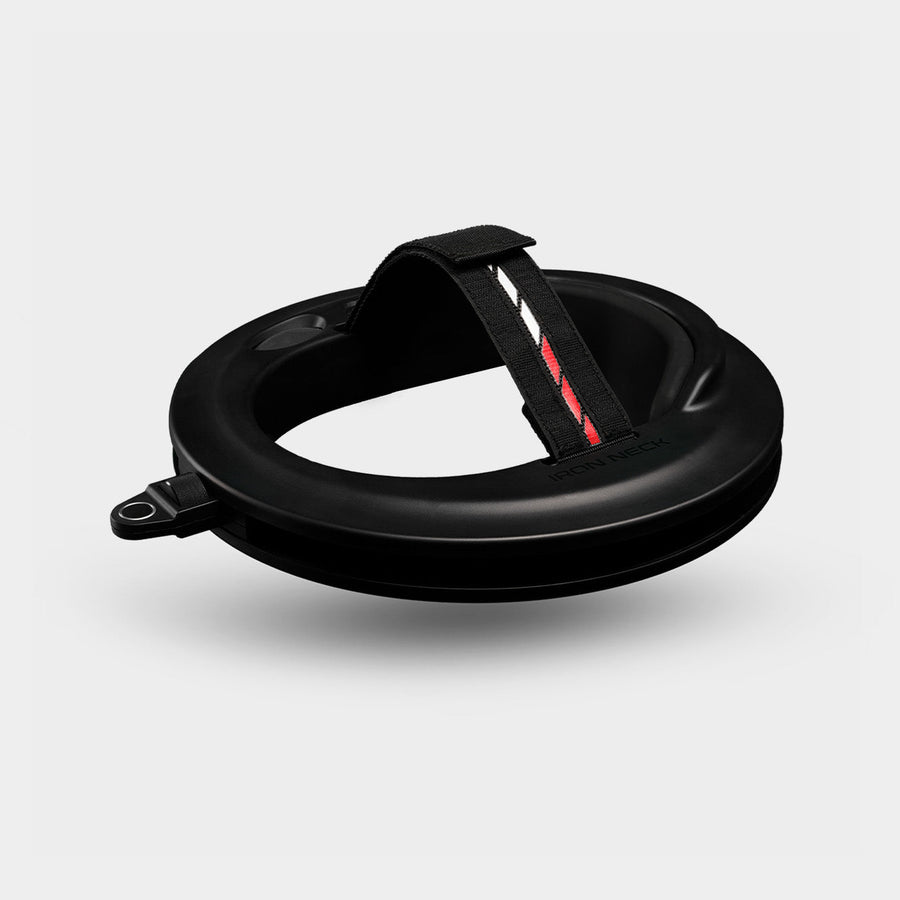
Train this program with the Iron Neck 3.0 Pro

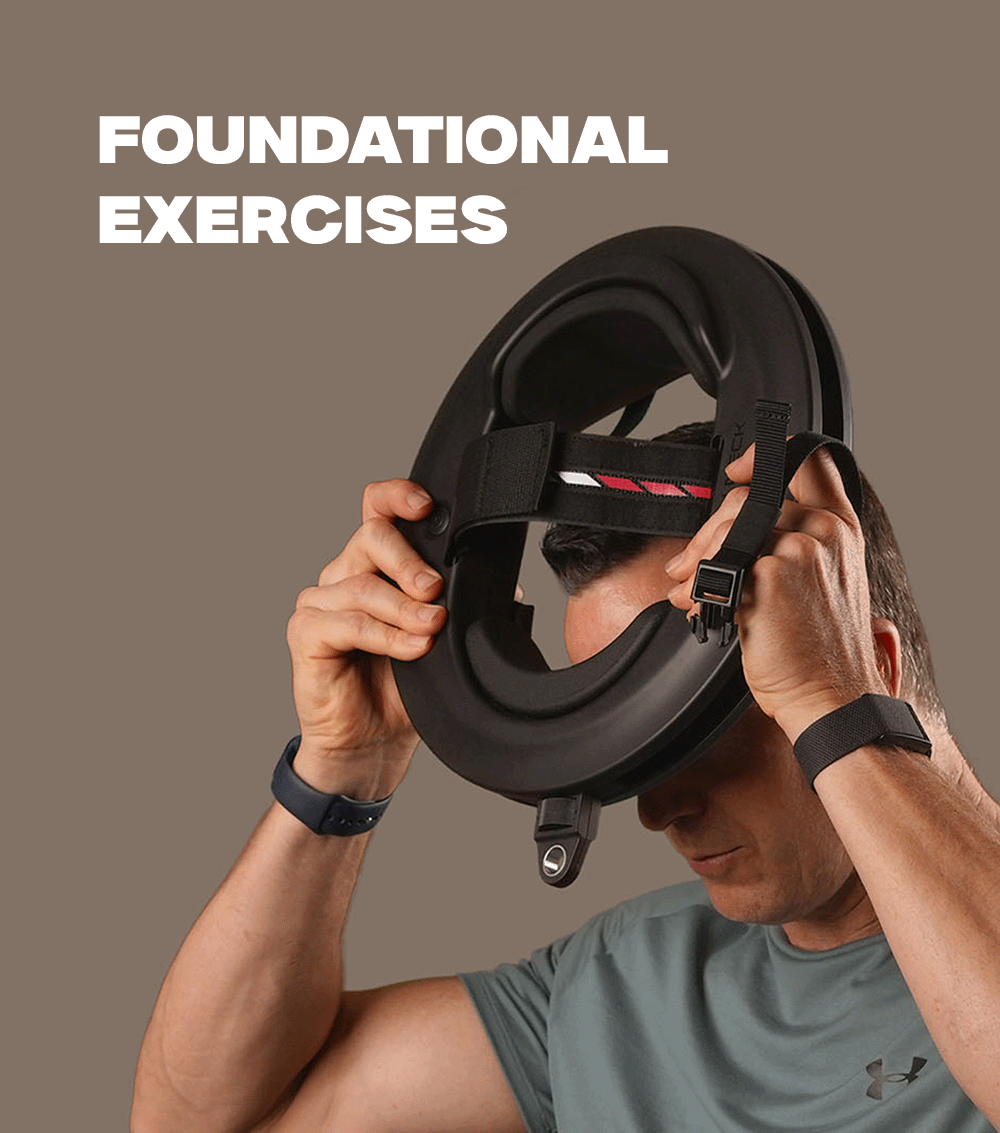
The 360 degree resistance head unit this program is built around, with the anchor and bands you need to train every direction from day one.

Iron Neck 3.0 Pro
Iron Neck 3.0 Pro $599.00
Set your resistance

Light, medium, or heavy?

We call for an effort level instead of a specific weight, because the right resistance depends on you, the movement, and where you are in your training. For the sets and reps listed on each exercise, pick the resistance that makes the last few reps feel like the level shown.

Light

You finish the set with several clean reps still in the tank. The work stays easy and fully controlled from the first rep to the last.

Medium

You could manage a few more reps at the end, but not many. The final reps take real effort while your form holds.

Heavy

You reach the last prescribed rep with little or nothing left. Completing every rep with good form is genuinely hard.

These are starting points, not rules. Everyone is built differently, so adjust to fit you: size down if your form breaks before the final rep or a movement aggravates a symptom, and only size up once every rep feels smooth and pain free. When you are unsure, choose the lighter option.