


Rehab & Recovery · Program 24

Kyphosis & Rounded Posture Support

A kyphotic upper back tips the whole neck forward, forcing it to crane upward all day just to keep the eyes level, which overworks the very muscles that then ache and fatigue. This program cannot straighten the thoracic curve, but it builds the cervical strength and alignment that let the neck live comfortably on top of one. Retraction endurance and upper cervical control do the heavy lifting here.

Focus · Rounded upper backFrequency · 3-4x per weekSession · 10-12 min
Kyphosis & Rounded Posture Support cover art
The goal

Counter the neck strain of a rounded upper back by building the cervical extension strength, retraction endurance, and head control that keep the eyes level.

Who it is for
  • Rounded upper back with neck ache from craning to see ahead
  • Postural kyphosis from age, desk decades, or build
  • Cleared for corrective strengthening

Lift the Gaze

Restore the retraction and rotation a kyphotic posture suppresses. The neck learns it can level the eyes without craning.

01Muscles worked in Protraction / RetractionDemo video coming soon

Protraction / Retraction

2 sets of 8 repsFront & Back

Retraction pulls the head back over the rounded thorax, the single movement that most reduces the moment arm straining a kyphotic neck.

How To
1Glide your head straight forward, reaching your chin outward, then glide it straight back as though making a double chin.
2Keep your eyes and chin level the entire time and move smoothly along a horizontal path.
Coaching Cues
Slide your head along an invisible shelf
Make a double chin
then get rid of it
No nodding
keep your eyes level throughout
Think forward and back
not up and down
Muscles Activated
SCMAnterior scaleneDeep neck flexorsSemispinalis cervicis
02

Look Left, Look Right

2 sets of 6 reps each sideAny direction

Level-chin rotation retrains clean turning, which a rounded back distorts into the tilt-and-swivel pattern that inflames the upper joints.

How To
1Stand tall with your chest up and your chin level.
2Turn your head slowly to one side as far as you can go comfortably, hold for a moment, then return to center and repeat to the other side.
3Only your head moves.
Coaching Cues
Chin stays level as you rotate
Eyes lead the movement
Do not tilt your head
it is a turn and not a lean
Move with control and not momentum
Muscles Activated
SCMSplenius capitis/cervicisLongissimus capitis
03Muscles worked in 360 SpinDemo video coming soon

360 Spin (small circle)

1 small circle each directionFront

A small circle frees the global stiffness that builds when the neck holds one craned position from breakfast to bedtime.

How To
1Stand tall with your shoulders stacked over your hips and fix your eyes on a point straight ahead.
2Rotate your body in place, hips, torso and feet, while your head stays completely still.
3Move slowly through a full clockwise turn, then reverse and complete a full counterclockwise turn.
Coaching Cues
Head still
body turns
Move like a tank turret with your upper body rotating under a fixed head
Do not let your nose drift from its anchor point
Feel the resistance wrap around you as you rotate
Muscles Activated
SCMSplenius capitis/cervicisSemispinalis capitisMultifidus

Advance whenAdvance when retraction is comfortable and the craned-forward ache eases on normal days.

Extension Endurance

Build the holding strength that keeps the head balanced over a curved spine. Endurance in retraction is the daily workhorse for this posture.

01Muscles worked in Protraction / RetractionDemo video coming soon

Protraction / Retraction (with hold)

2 sets of 6 reps with 3 second holdsFront & Back

Retraction holds build the sustained deep flexor and extensor teamwork a kyphotic frame demands every waking hour.

How To
1Glide your head straight forward, reaching your chin outward, then glide it straight back as though making a double chin.
2Keep your eyes and chin level the entire time and move smoothly along a horizontal path.
Coaching Cues
Slide your head along an invisible shelf
Make a double chin
then get rid of it
No nodding
keep your eyes level throughout
Think forward and back
not up and down
Muscles Activated
SCMAnterior scaleneDeep neck flexorsSemispinalis cervicis
02Muscles worked in Protraction / RetractionDemo video coming soon

Protraction / Retraction (tempo 3-1-3)

2 sets of 6 repsFront & Back

The 3-1-3 tempo strengthens control through the whole glide path, so the head lowers and lifts deliberately instead of hanging off the curve.

How To
1Glide your head straight forward, reaching your chin outward, then glide it straight back as though making a double chin.
2Keep your eyes and chin level the entire time and move smoothly along a horizontal path.
Coaching Cues
Slide your head along an invisible shelf
Make a double chin
then get rid of it
No nodding
keep your eyes level throughout
Think forward and back
not up and down
Muscles Activated
SCMAnterior scaleneDeep neck flexorsSemispinalis cervicis
03Muscles worked in Isometric HoldDemo video coming soon

Isometric Hold

3 sets of 15 second holdsFront

Neutral bracing teaches the neck to carry head weight through its bones rather than through the strained muscles a kyphotic angle overuses.

How To
1Set your head in the working position and hold it there against the band.
2Keep your chin level, breathe normally, and resist any drift for the full time prescribed.
Coaching Cues
Brace your neck without clenching your jaw
Keep breathing through the hold
Nothing moves but your ribs
End the set when your position starts to drift
Muscles Activated
Deep neck flexors/extensorsSCMSplenius

Advance whenAdvance when holds are solid and the head sits back without conscious effort for hours at a stretch.

Posture Under Load

Strengthen the corrected position at its end range and through combined planes. The neck gains the capacity to hold its ground against the curve below it.

01Muscles worked in Protraction / RetractionDemo video coming soon

Protraction / Retraction (end-range hold)

3 holds of 10 seconds each positionFront & Back

End-range retraction isometrics build strength at maximum correction, extending how far back a kyphosis-tipped head can comfortably sit.

How To
1Glide your head straight forward, reaching your chin outward, then glide it straight back as though making a double chin.
2Keep your eyes and chin level the entire time and move smoothly along a horizontal path.
Coaching Cues
Slide your head along an invisible shelf
Make a double chin
then get rid of it
No nodding
keep your eyes level throughout
Think forward and back
not up and down
Muscles Activated
SCMAnterior scaleneDeep neck flexorsSemispinalis cervicis
02Muscles worked in 360 SpinDemo video coming soon

360 Spin (slow tempo)

2 slow rotations each directionFront

Slow circles build balanced endurance so the correction holds during movement, not only in a posed standing position.

How To
1Stand tall with your shoulders stacked over your hips and fix your eyes on a point straight ahead.
2Rotate your body in place, hips, torso and feet, while your head stays completely still.
3Move slowly through a full clockwise turn, then reverse and complete a full counterclockwise turn.
Coaching Cues
Head still
body turns
Move like a tank turret with your upper body rotating under a fixed head
Do not let your nose drift from its anchor point
Feel the resistance wrap around you as you rotate
Muscles Activated
SCMSplenius capitis/cervicisSemispinalis capitisMultifidus
03Muscles worked in DiagonalsDemo video coming soon

Diagonals (slow tempo)

2 sets of 4 reps each diagonalFront or Back

Slow diagonals strengthen the upward-and-across gaze patterns a rounded back makes strenuous, like checking mirrors or reaching a top shelf.

How To
1Start by looking down toward one armpit.
2Trace a diagonal path upward with your eyes and nose until you are looking above the opposite shoulder, then return along the same path.
3Finish your reps on one side before switching to the opposite diagonal.
Coaching Cues
Draw an X in your field of view with your nose
Follow a diagonal line with your eyes
Use full range but keep it smooth
Feel your neck twist and lengthen
Muscles Activated
SCMSplenius capitisScalenesSuboccipitals

Advance whenAdvance when end-range holds are strong and evening neck fatigue has largely disappeared.

Upright for Good

Maintain the compensating strength permanently. The thoracic curve may stay, but the neck above it stays strong, level, and quiet.

01Muscles worked in Protraction / RetractionDemo video coming soon

Protraction / Retraction (with hold)

2 sets of 8 reps with 3 second holdsFront & Back

Loaded retraction holds keep the counter-craning muscles strong enough to outlast every day the curve throws at them.

How To
1Glide your head straight forward, reaching your chin outward, then glide it straight back as though making a double chin.
2Keep your eyes and chin level the entire time and move smoothly along a horizontal path.
Coaching Cues
Slide your head along an invisible shelf
Make a double chin
then get rid of it
No nodding
keep your eyes level throughout
Think forward and back
not up and down
Muscles Activated
SCMAnterior scaleneDeep neck flexorsSemispinalis cervicis
02Muscles worked in DiagonalsDemo video coming soon

Diagonals (full range)

2 sets of 6 reps each diagonalFront or Back

Loaded full-range diagonals maintain all-plane capacity so the compensating posture never trades one stiffness for another.

How To
1Start by looking down toward one armpit.
2Trace a diagonal path upward with your eyes and nose until you are looking above the opposite shoulder, then return along the same path.
3Finish your reps on one side before switching to the opposite diagonal.
Coaching Cues
Draw an X in your field of view with your nose
Follow a diagonal line with your eyes
Use full range but keep it smooth
Feel your neck twist and lengthen
Muscles Activated
SCMSplenius capitisScalenesSuboccipitals
03Muscles worked in 360 SpinDemo video coming soon

360 Spin (eyes closed)

1 rotation each directionFront

Eyes-closed circles keep position sense honest, since a kyphotic frame makes the head drift forward the moment attention lapses.

How To
1Stand tall with your shoulders stacked over your hips and fix your eyes on a point straight ahead.
2Rotate your body in place, hips, torso and feet, while your head stays completely still.
3Move slowly through a full clockwise turn, then reverse and complete a full counterclockwise turn.
Coaching Cues
Head still
body turns
Move like a tank turret with your upper body rotating under a fixed head
Do not let your nose drift from its anchor point
Feel the resistance wrap around you as you rotate
Muscles Activated
SCMSplenius capitis/cervicisSemispinalis capitisMultifidus
Get the gear

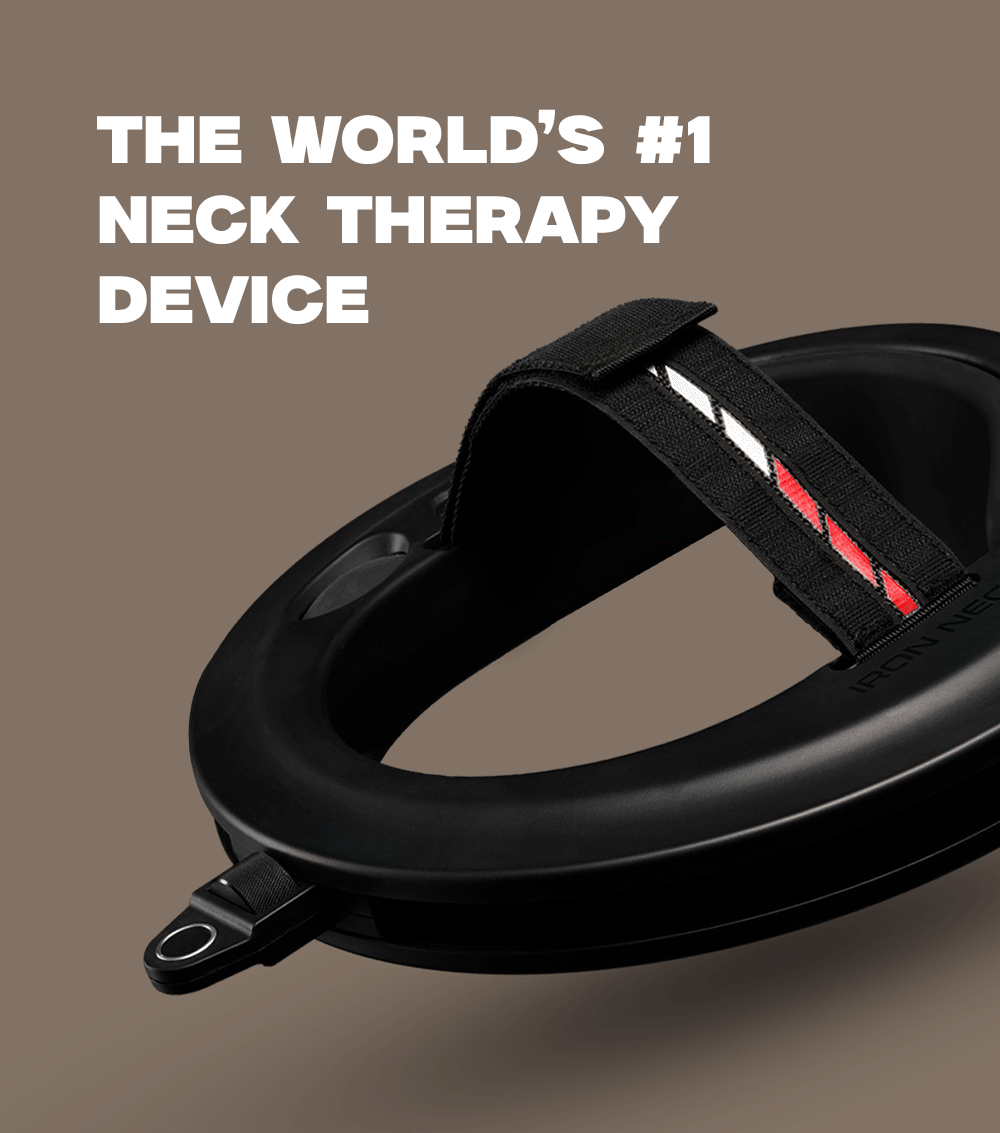
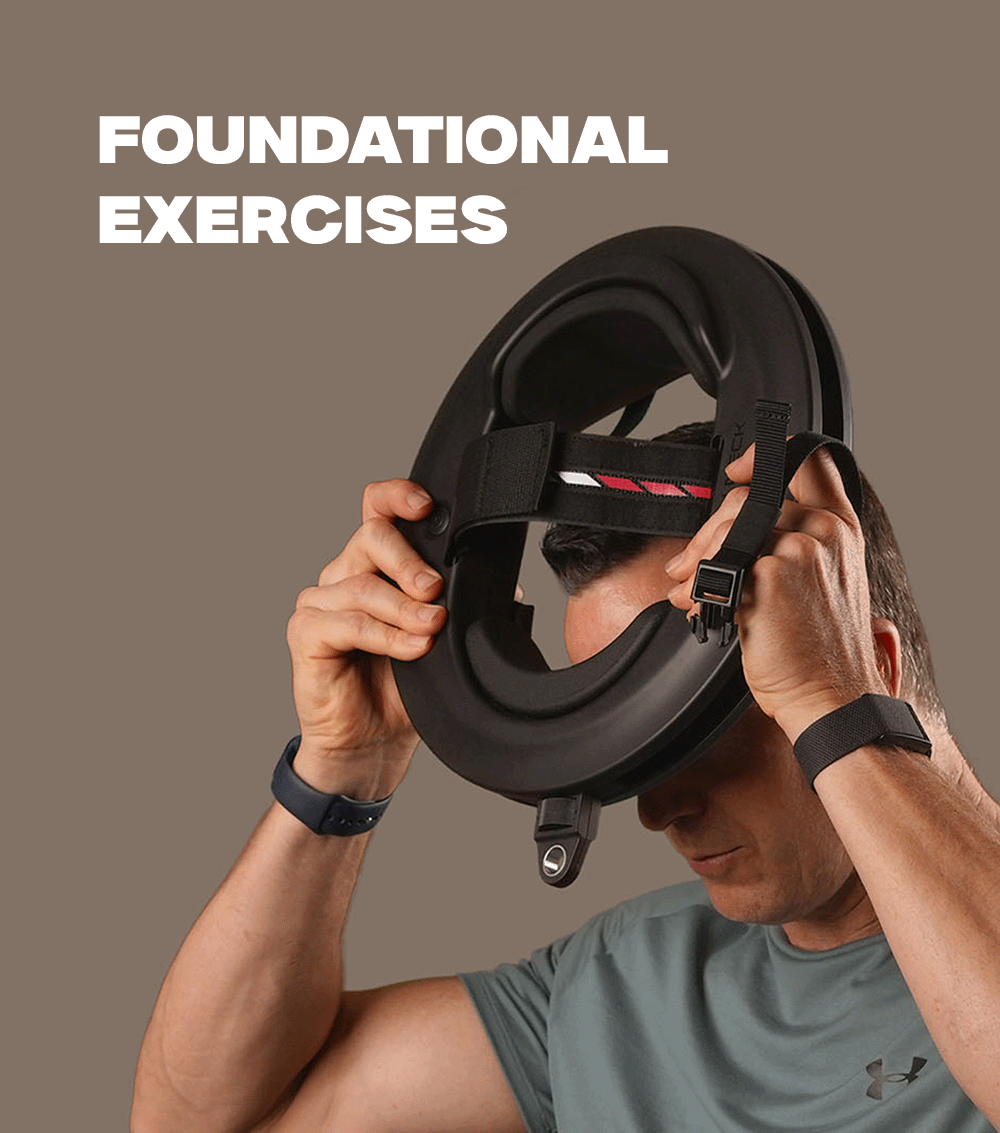
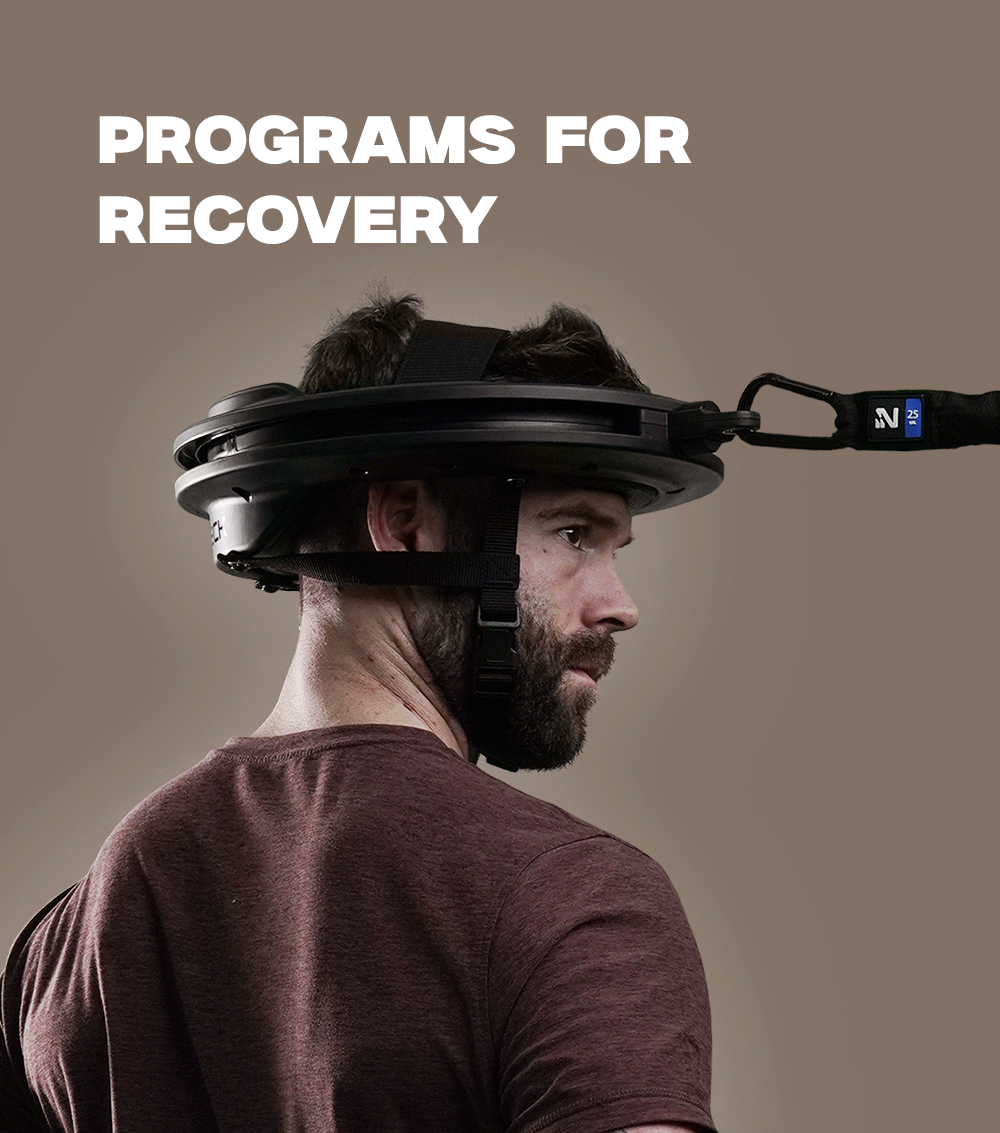
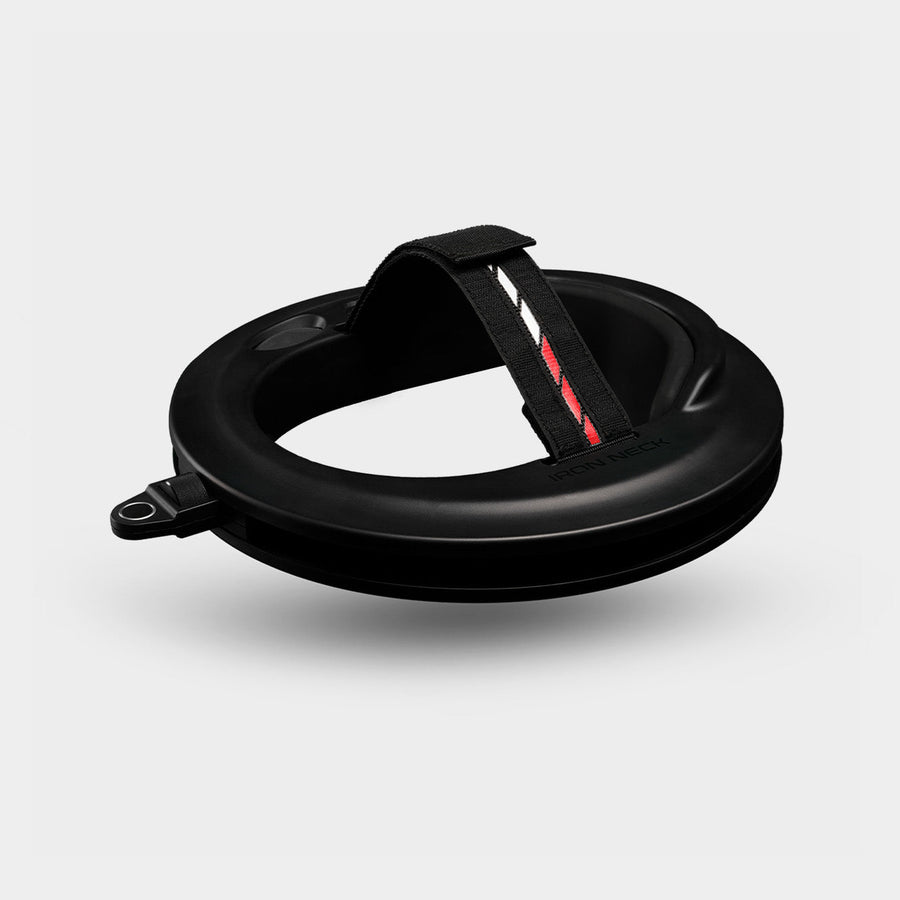
Train this program with the Iron Neck 3.0 Pro

The 360 degree resistance head unit this program is built around, with the anchor and bands you need to train every direction from day one.

Iron Neck 3.0 Pro
Iron Neck 3.0 Pro $599.00
Set your resistance

Light, medium, or heavy?

We call for an effort level instead of a specific weight, because the right resistance depends on you, the movement, and where you are in your training. For the sets and reps listed on each exercise, pick the resistance that makes the last few reps feel like the level shown.

Light

You finish the set with several clean reps still in the tank. The work stays easy and fully controlled from the first rep to the last.

Medium

You could manage a few more reps at the end, but not many. The final reps take real effort while your form holds.

Heavy

You reach the last prescribed rep with little or nothing left. Completing every rep with good form is genuinely hard.

These are starting points, not rules. Everyone is built differently, so adjust to fit you: size down if your form breaks before the final rep or a movement aggravates a symptom, and only size up once every rep feels smooth and pain free. When you are unsure, choose the lighter option.