

Rehab & Recovery · Program 21

Age Strong: Neck Health 55+

After 55, neck rotation quietly shrinks, deep stabilizers weaken, and the head control that underpins balance starts to fade, often unnoticed until a shoulder check or a stumble exposes it. This program rebuilds those capacities with joint-friendly doses that respect older tissue while still demanding real adaptation. The payoff is practical: freer driving checks, steadier balance, and a neck that supports another few decades of activity.

Focus · Active adults 55+Frequency · 3x per weekSession · 10-12 min
Age Strong: Neck Health 55+ cover art
The goal

Preserve neck mobility, strength, and head control past 55 to protect independence, driving confidence, and balance.

Who it is for
  • Adults 55 and older noticing neck stiffness or shrinking rotation
  • Wanting to protect driving confidence, balance, and independence
  • New to neck training or returning after years away

Move Well Again

Restore comfortable motion in the ranges age quietly takes first. Consistency at easy intensity rebuilds the habit of moving the neck at all.

01Muscles worked in 360 SpinDemo video coming soon

360 Spin (small circle)

1 small circle each directionFront

A gentle reduced arc reintroduces all-direction movement to joints that decades of straight-ahead habits have narrowed.

How To
1Stand tall with your shoulders stacked over your hips and fix your eyes on a point straight ahead.
2Rotate your body in place, hips, torso and feet, while your head stays completely still.
3Move slowly through a full clockwise turn, then reverse and complete a full counterclockwise turn.
Coaching Cues
Head still
body turns
Move like a tank turret with your upper body rotating under a fixed head
Do not let your nose drift from its anchor point
Feel the resistance wrap around you as you rotate
Muscles Activated
SCMSplenius capitis/cervicisSemispinalis capitisMultifidus
02

Look Left, Look Right

2 sets of 6 reps each sideAny direction

Deliberate turning practice directly rebuilds the shoulder-check rotation that age erodes fastest and driving depends on most.

How To
1Stand tall with your chest up and your chin level.
2Turn your head slowly to one side as far as you can go comfortably, hold for a moment, then return to center and repeat to the other side.
3Only your head moves.
Coaching Cues
Chin stays level as you rotate
Eyes lead the movement
Do not tilt your head
it is a turn and not a lean
Move with control and not momentum
Muscles Activated
SCMSplenius capitis/cervicisLongissimus capitis
03Muscles worked in Protraction / RetractionDemo video coming soon

Protraction / Retraction

2 sets of 8 repsFront & Back

Gliding reverses the forward head drift that settles in over decades, re-stacking the head where an older spine carries it best.

How To
1Glide your head straight forward, reaching your chin outward, then glide it straight back as though making a double chin.
2Keep your eyes and chin level the entire time and move smoothly along a horizontal path.
Coaching Cues
Slide your head along an invisible shelf
Make a double chin
then get rid of it
No nodding
keep your eyes level throughout
Think forward and back
not up and down
Muscles Activated
SCMAnterior scaleneDeep neck flexorsSemispinalis cervicis

Advance whenAdvance when all three drills feel smooth and rotation range has visibly improved.

Steady Strength

Add holds and sustained work to rebuild muscle that age has thinned. Strength gains come readily at this dose, even after 70.

01Muscles worked in 360 SpinDemo video coming soon

360 Spin (slow tempo)

2 slow rotations each directionFront

Slow circles build endurance across every neck muscle at once, efficient training for the session lengths older necks recover from best.

How To
1Stand tall with your shoulders stacked over your hips and fix your eyes on a point straight ahead.
2Rotate your body in place, hips, torso and feet, while your head stays completely still.
3Move slowly through a full clockwise turn, then reverse and complete a full counterclockwise turn.
Coaching Cues
Head still
body turns
Move like a tank turret with your upper body rotating under a fixed head
Do not let your nose drift from its anchor point
Feel the resistance wrap around you as you rotate
Muscles Activated
SCMSplenius capitis/cervicisSemispinalis capitisMultifidus
02Muscles worked in Protraction / RetractionDemo video coming soon

Protraction / Retraction (with hold)

2 sets of 6 reps with 3 second holdsFront & Back

Retraction holds strengthen the deep flexors that keep an aging head upright, the posture muscle group sarcopenia hits hardest.

How To
1Glide your head straight forward, reaching your chin outward, then glide it straight back as though making a double chin.
2Keep your eyes and chin level the entire time and move smoothly along a horizontal path.
Coaching Cues
Slide your head along an invisible shelf
Make a double chin
then get rid of it
No nodding
keep your eyes level throughout
Think forward and back
not up and down
Muscles Activated
SCMAnterior scaleneDeep neck flexorsSemispinalis cervicis
03

Look Left, Look Right (with hold)

2 sets of 4 reps each side with 3 second holdsAny direction

End-range rotational holds cement the recovered turning range, because at this age range unused is range lost.

How To
1Stand tall with your chest up and your chin level.
2Turn your head slowly to one side as far as you can go comfortably, hold for a moment, then return to center and repeat to the other side.
3Only your head moves.
Coaching Cues
Chin stays level as you rotate
Eyes lead the movement
Do not tilt your head
it is a turn and not a lean
Move with control and not momentum
Muscles Activated
SCMSplenius capitis/cervicisLongissimus capitis

Advance whenAdvance when holds feel solid and everyday head movement feels noticeably lighter and freer.

Capacity + Coordination

Train combined planes and precise control, the qualities that connect neck health to balance. This phase is where fall protection is actually built.

01Muscles worked in DiagonalsDemo video coming soon

Diagonals (slow tempo)

2 sets of 4 reps each diagonalFront or Back

Slow diagonals restore the oblique patterns used in checking blind spots and glancing at curbs, movements that keep older adults safe.

How To
1Start by looking down toward one armpit.
2Trace a diagonal path upward with your eyes and nose until you are looking above the opposite shoulder, then return along the same path.
3Finish your reps on one side before switching to the opposite diagonal.
Coaching Cues
Draw an X in your field of view with your nose
Follow a diagonal line with your eyes
Use full range but keep it smooth
Feel your neck twist and lengthen
Muscles Activated
SCMSplenius capitisScalenesSuboccipitals
02Muscles worked in 360 SpinDemo video coming soon

360 Spin (quarter pauses)

1 set each direction with pauses at each quarterFront

Holding a still head at each quarter builds the head-on-body control the balance system relies on when footing gets uncertain.

How To
1Stand tall with your shoulders stacked over your hips and fix your eyes on a point straight ahead.
2Rotate your body in place, hips, torso and feet, while your head stays completely still.
3Move slowly through a full clockwise turn, then reverse and complete a full counterclockwise turn.
Coaching Cues
Head still
body turns
Move like a tank turret with your upper body rotating under a fixed head
Do not let your nose drift from its anchor point
Feel the resistance wrap around you as you rotate
Muscles Activated
SCMSplenius capitis/cervicisSemispinalis capitisMultifidus
03Muscles worked in Isometric HoldDemo video coming soon

Isometric Hold (in rotation)

3 sets of 15 second holds each sideFront

Rotational isometrics build turning strength without joint wear, ideal for arthritic necks that still need to get stronger.

How To
1Set your head in the working position and hold it there against the band.
2Keep your chin level, breathe normally, and resist any drift for the full time prescribed.
Coaching Cues
Brace your neck without clenching your jaw
Keep breathing through the hold
Nothing moves but your ribs
End the set when your position starts to drift
Muscles Activated
SCMSplenius capitis/cervicisLongissimus capitis

Advance whenAdvance when diagonal and pause work is accurate and steady with no lingering fatigue.

Independence Insurance

Maintain everything for the long run with a sustainable routine. This phase is designed to be done at 65, 75, and beyond.

01Muscles worked in DiagonalsDemo video coming soon

Diagonals (full range)

2 sets of 4 reps each diagonalFront or Back

Full-range diagonals keep every plane of motion alive, defending the functional range this program restored.

How To
1Start by looking down toward one armpit.
2Trace a diagonal path upward with your eyes and nose until you are looking above the opposite shoulder, then return along the same path.
3Finish your reps on one side before switching to the opposite diagonal.
Coaching Cues
Draw an X in your field of view with your nose
Follow a diagonal line with your eyes
Use full range but keep it smooth
Feel your neck twist and lengthen
Muscles Activated
SCMSplenius capitisScalenesSuboccipitals
02Muscles worked in 360 SpinDemo video coming soon

360 Spin (eyes closed)

1 rotation each directionFront

Eyes-closed circles train the head positioning reflexes that help catch a stumble before it becomes a fall.

How To
1Stand tall with your shoulders stacked over your hips and fix your eyes on a point straight ahead.
2Rotate your body in place, hips, torso and feet, while your head stays completely still.
3Move slowly through a full clockwise turn, then reverse and complete a full counterclockwise turn.
Coaching Cues
Head still
body turns
Move like a tank turret with your upper body rotating under a fixed head
Do not let your nose drift from its anchor point
Feel the resistance wrap around you as you rotate
Muscles Activated
SCMSplenius capitis/cervicisSemispinalis capitisMultifidus
03Muscles worked in Protraction / RetractionDemo video coming soon

Protraction / Retraction (tempo 3-1-3)

2 sets of 6 repsFront & Back

Moderate-load gliding keeps the postural muscles adapting, because maintenance after 55 still requires progressive stimulus, not just repetition.

How To
1Glide your head straight forward, reaching your chin outward, then glide it straight back as though making a double chin.
2Keep your eyes and chin level the entire time and move smoothly along a horizontal path.
Coaching Cues
Slide your head along an invisible shelf
Make a double chin
then get rid of it
No nodding
keep your eyes level throughout
Think forward and back
not up and down
Muscles Activated
SCMAnterior scaleneDeep neck flexorsSemispinalis cervicis
Get the gear

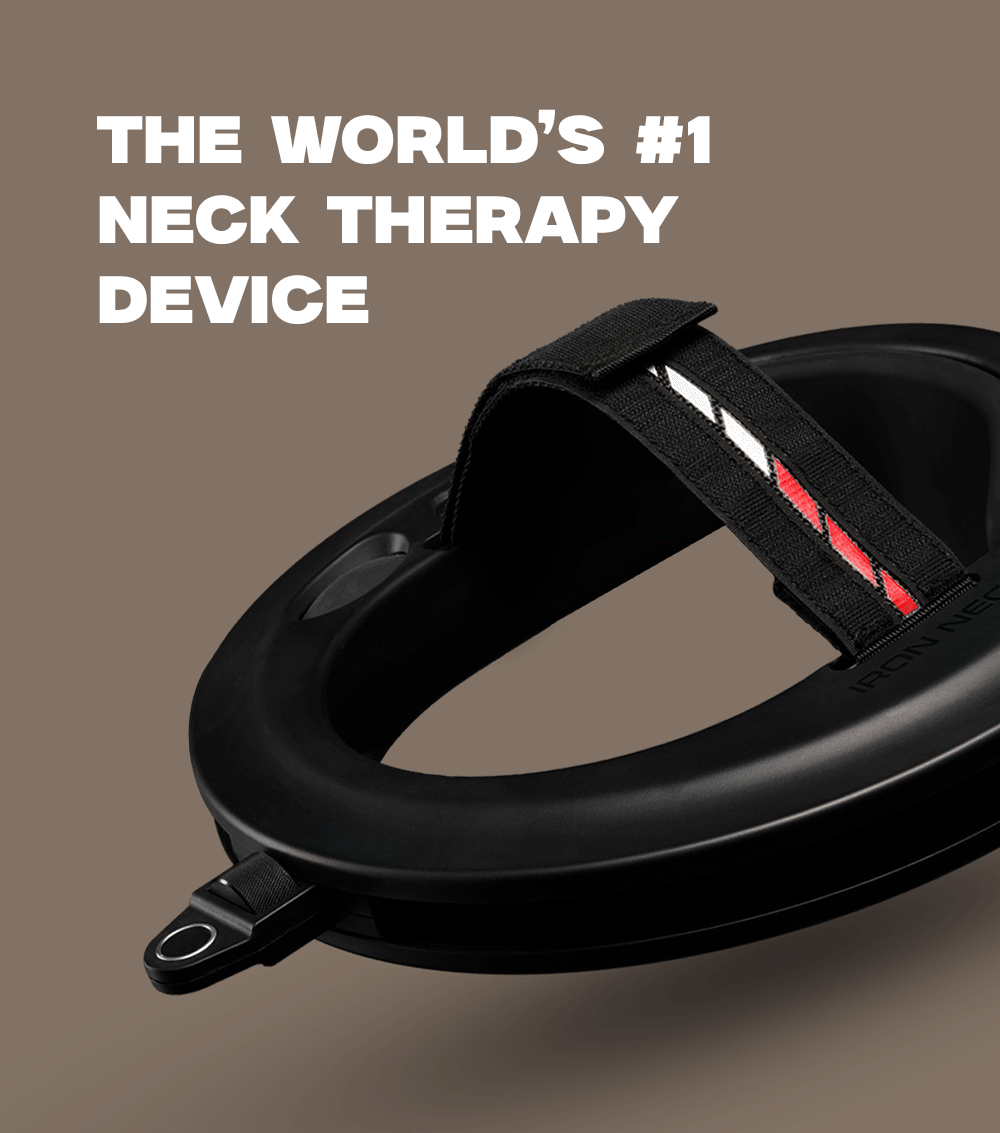
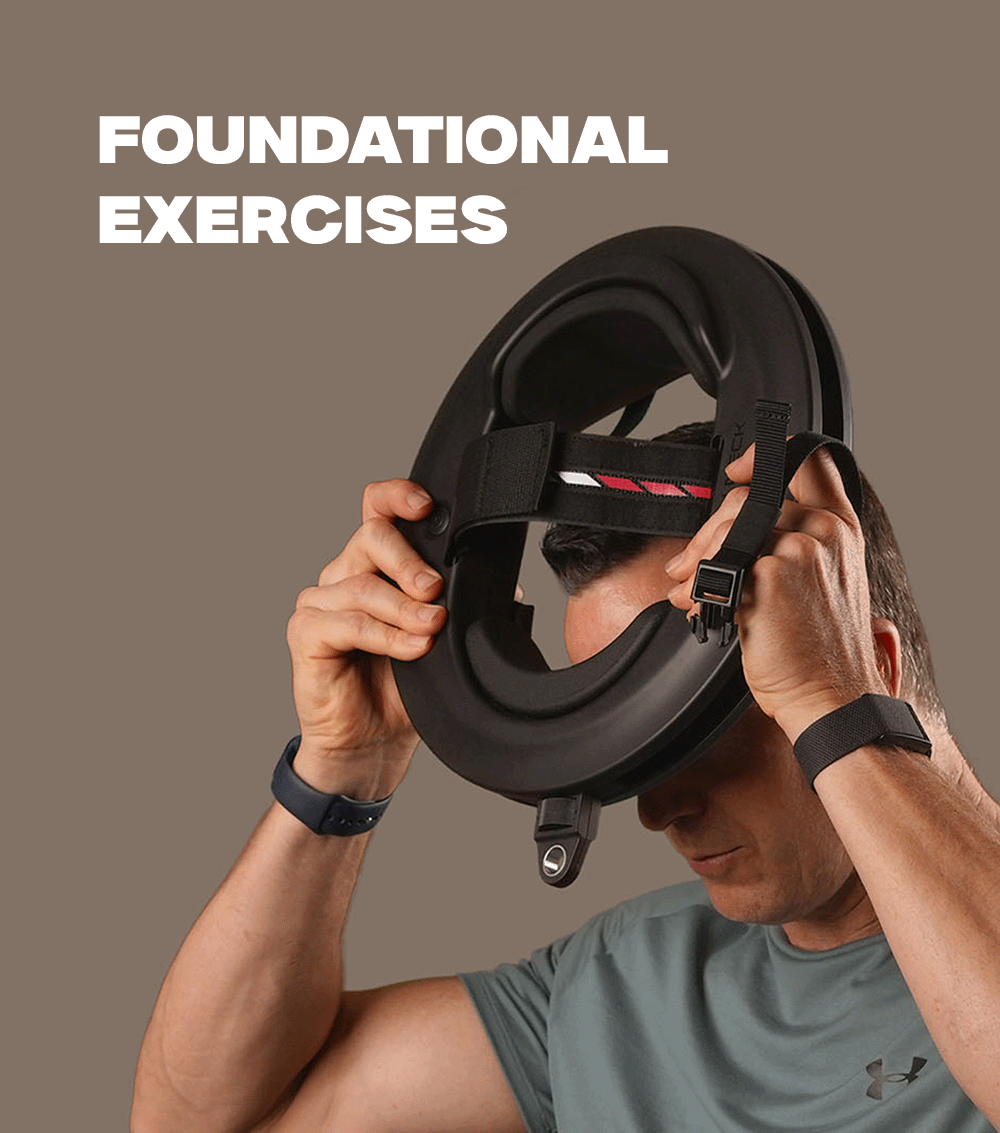
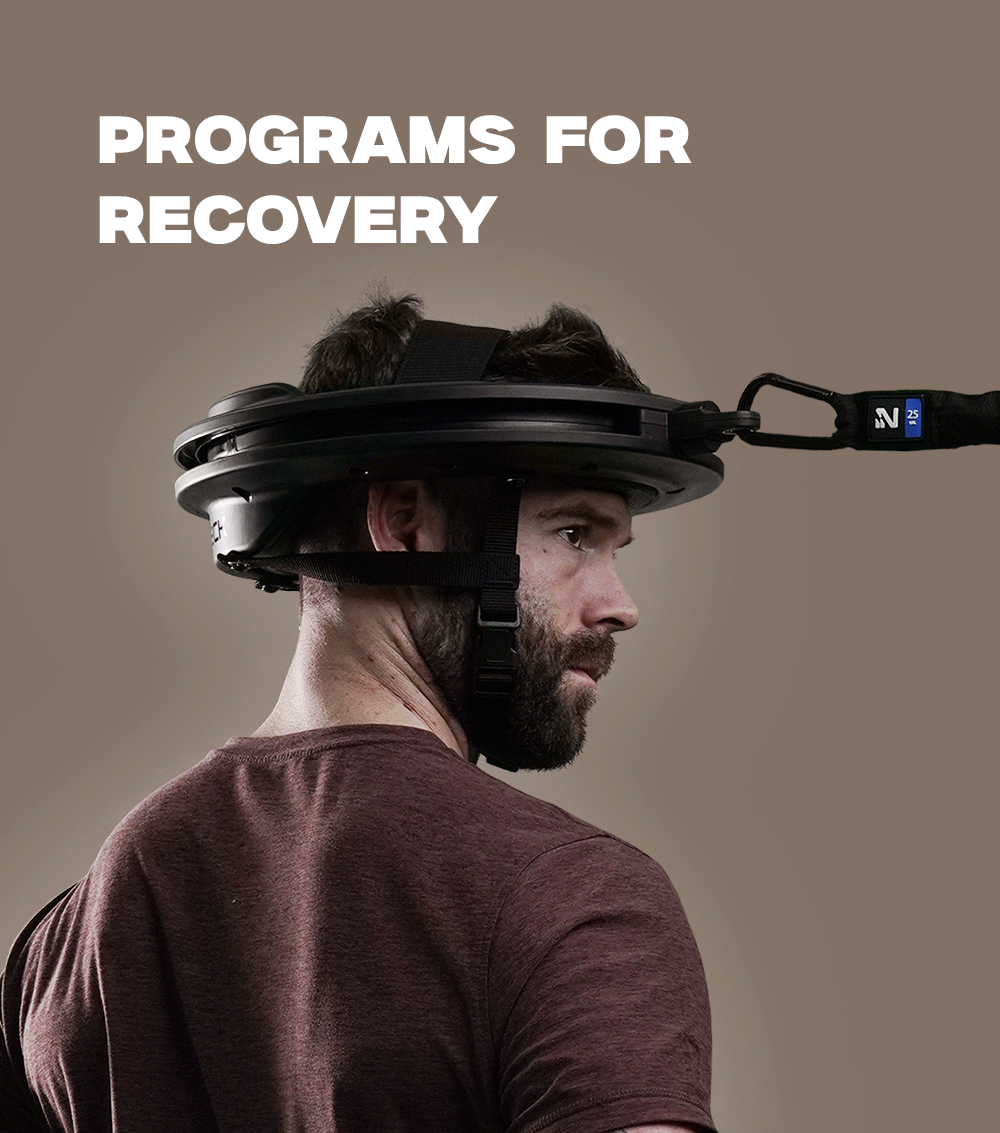
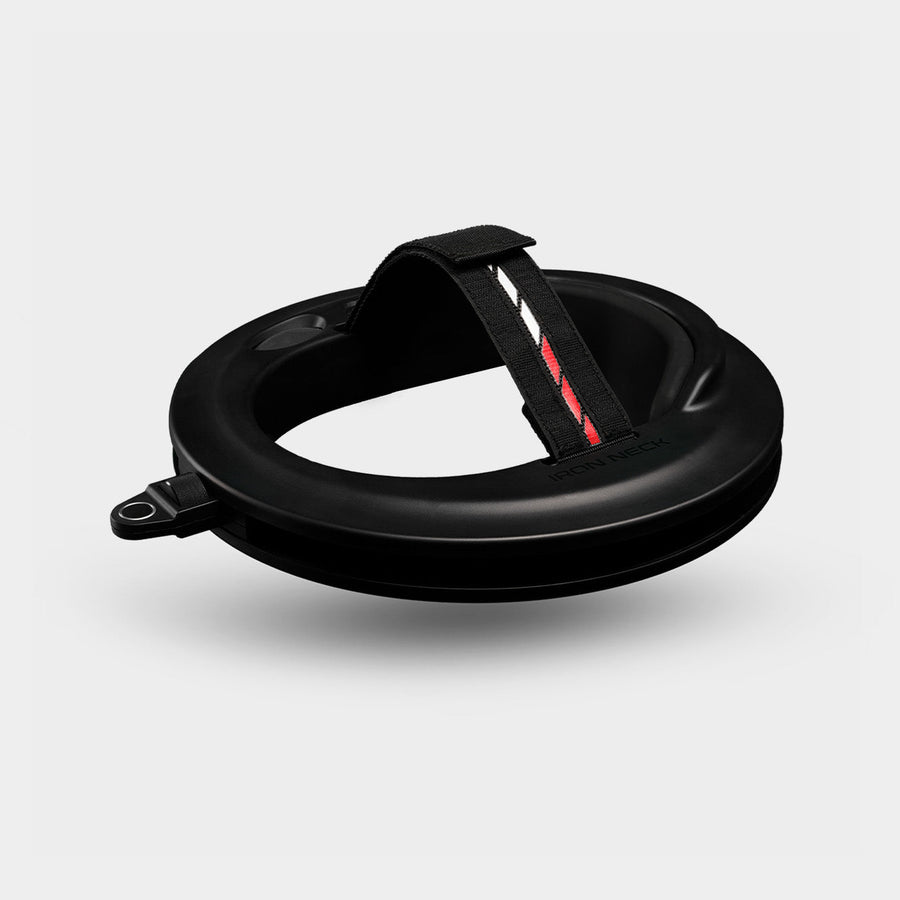
Train this program with the Iron Neck 3.0 Pro

The 360 degree resistance head unit this program is built around, with the anchor and bands you need to train every direction from day one.

Iron Neck 3.0 Pro
Iron Neck 3.0 Pro $599.00
Set your resistance

Light, medium, or heavy?

We call for an effort level instead of a specific weight, because the right resistance depends on you, the movement, and where you are in your training. For the sets and reps listed on each exercise, pick the resistance that makes the last few reps feel like the level shown.

Light

You finish the set with several clean reps still in the tank. The work stays easy and fully controlled from the first rep to the last.

Medium

You could manage a few more reps at the end, but not many. The final reps take real effort while your form holds.

Heavy

You reach the last prescribed rep with little or nothing left. Completing every rep with good form is genuinely hard.

These are starting points, not rules. Everyone is built differently, so adjust to fit you: size down if your form breaks before the final rep or a movement aggravates a symptom, and only size up once every rep feels smooth and pain free. When you are unsure, choose the lighter option.