


Rehab & Recovery · Program 11

Cervical Disc Herniation Recovery

A herniated cervical disc turns ordinary head movement into a calculated risk, often with neck pain and symptoms that threaten to travel down the arm. This program is built around retraction-biased gliding that encourages the disc away from sensitive structures, then adds strength in careful grades the healing tissue can absorb. By the final phase the neck moves through every plane with the support a compromised disc needs.

Focus · Disc herniationFrequency · 3-4x per weekSession · 12-15 min
Cervical Disc Herniation Recovery cover art
The goal

Support disc healing and restore pain-free motion by rebuilding cervical alignment, deep stabilizer strength, and graded load tolerance.

Who it is for
  • Diagnosed cervical disc herniation or bulge, cleared for active rehab
  • Neck pain with occasional arm symptoms when posture slips
  • Wanting a structured path from protection back to full movement

Symptom Calming + Retraction Bias

Establish the retracted alignment that takes pressure off the injured disc and reintroduce gentle motion around it. Any movement that pushes symptoms toward the arm is a signal to shrink the range.

01

Protraction / Retraction

2 sets of 8 repsFront & Back

The retraction phase of each rep draws the head back over the spine, the position that reduces posterior disc pressure and centralizes symptoms.

How To
1Glide your head straight forward, reaching your chin outward, then glide it straight back as though making a double chin.
2Keep your eyes and chin level the entire time and move smoothly along a horizontal path.
Coaching Cues
Slide your head along an invisible shelf
Make a double chin
then get rid of it
No nodding
keep your eyes level throughout
Think forward and back
not up and down
Muscles Activated
SCMAnterior scaleneDeep neck flexorsSemispinalis cervicis
02

360 Spin (light tension)

1 slow rotation each directionFront

Near-zero tension through a full circle nourishes the disc with gentle, varied load, exactly the stimulus healing disc tissue responds to.

How To
1Stand tall with your shoulders stacked over your hips and fix your eyes on a point straight ahead.
2Rotate your body in place, hips, torso and feet, while your head stays completely still.
3Move slowly through a full clockwise turn, then reverse and complete a full counterclockwise turn.
Coaching Cues
Head still
body turns
Move like a tank turret with your upper body rotating under a fixed head
Do not let your nose drift from its anchor point
Feel the resistance wrap around you as you rotate
Muscles Activated
SCMSplenius capitis/cervicisSemispinalis capitisMultifidus
03

Look Left, Look Right

2 sets of 6 reps each sideAny direction

Controlled mid-range rotation keeps the neck mobile without the combined extension and turning that loads the herniated segment hardest.

How To
1Stand tall with your chest up and your chin level.
2Turn your head slowly to one side as far as you can go comfortably, hold for a moment, then return to center and repeat to the other side.
3Only your head moves.
Coaching Cues
Chin stays level as you rotate
Eyes lead the movement
Do not tilt your head
it is a turn and not a lean
Move with control and not momentum
Muscles Activated
SCMSplenius capitis/cervicisLongissimus capitis

Advance whenAdvance when gliding and light rotation are comfortable and symptoms stay centralized to the neck.

Postural Control + Endurance

Make the disc-friendly alignment strong enough to last all day. Deep flexor endurance is the single best protection a healing disc can have.

01

Protraction / Retraction (with hold)

2 sets of 6 reps with 3 second holdsFront & Back

Retraction holds extend the time the disc spends in its lowest-pressure position, turning moments of relief into a sustained healing environment.

How To
1Glide your head straight forward, reaching your chin outward, then glide it straight back as though making a double chin.
2Keep your eyes and chin level the entire time and move smoothly along a horizontal path.
Coaching Cues
Slide your head along an invisible shelf
Make a double chin
then get rid of it
No nodding
keep your eyes level throughout
Think forward and back
not up and down
Muscles Activated
SCMAnterior scaleneDeep neck flexorsSemispinalis cervicis
02

Protraction / Retraction (tempo 3-1-3)

2 sets of 6 repsFront & Back

The slow 3-1-3 tempo builds eccentric control of the glide so the head never falls forward into the posture that spikes disc load.

How To
1Glide your head straight forward, reaching your chin outward, then glide it straight back as though making a double chin.
2Keep your eyes and chin level the entire time and move smoothly along a horizontal path.
Coaching Cues
Slide your head along an invisible shelf
Make a double chin
then get rid of it
No nodding
keep your eyes level throughout
Think forward and back
not up and down
Muscles Activated
SCMAnterior scaleneDeep neck flexorsSemispinalis cervicis
03

Isometric Hold

3 sets of 15 second holdsFront

Neutral bracing endurance keeps the segment stable between sessions, protecting the disc during the hours you are not training.

How To
1Set your head in the working position and hold it there against the band.
2Keep your chin level, breathe normally, and resist any drift for the full time prescribed.
Coaching Cues
Brace your neck without clenching your jaw
Keep breathing through the hold
Nothing moves but your ribs
End the set when your position starts to drift
Muscles Activated
Deep neck flexors/extensorsSCMSplenius

Advance whenAdvance after two weeks of hold and tempo work with symptoms steadily shrinking, never spreading.

Graded Loading

Introduce combined planes and longer efforts at a dose healing tissue can adapt to. The disc gets progressively stronger stimulus without ever being surprised.

01

Diagonals (shallow range)

2 sets of 4 reps each diagonalFront or Back

Shallow diagonals reintroduce the flexion-rotation combinations of daily life at a depth the recovering disc can tolerate and adapt to.

How To
1Start by looking down toward one armpit.
2Trace a diagonal path upward with your eyes and nose until you are looking above the opposite shoulder, then return along the same path.
3Finish your reps on one side before switching to the opposite diagonal.
Coaching Cues
Draw an X in your field of view with your nose
Follow a diagonal line with your eyes
Use full range but keep it smooth
Feel your neck twist and lengthen
Muscles Activated
SCMSplenius capitisScalenesSuboccipitals
02

360 Spin (slow tempo)

2 slow rotations each directionFront

Extended slow circles build endurance while cycling the disc through gentle, even compression that supports tissue remodeling.

How To
1Stand tall with your shoulders stacked over your hips and fix your eyes on a point straight ahead.
2Rotate your body in place, hips, torso and feet, while your head stays completely still.
3Move slowly through a full clockwise turn, then reverse and complete a full counterclockwise turn.
Coaching Cues
Head still
body turns
Move like a tank turret with your upper body rotating under a fixed head
Do not let your nose drift from its anchor point
Feel the resistance wrap around you as you rotate
Muscles Activated
SCMSplenius capitis/cervicisSemispinalis capitisMultifidus
03

Isometric Hold (in rotation)

3 sets of 20 second holds each sideFront

Isometric strength at rotated positions stabilizes the injured level during head turns, the everyday motion most likely to tweak it.

How To
1Set your head in the working position and hold it there against the band.
2Keep your chin level, breathe normally, and resist any drift for the full time prescribed.
Coaching Cues
Brace your neck without clenching your jaw
Keep breathing through the hold
Nothing moves but your ribs
End the set when your position starts to drift
Muscles Activated
SCMSplenius capitis/cervicisLongissimus capitis

Advance whenAdvance when shallow diagonals and rotational holds are strong with the neck fully quiet for two weeks.

Resilient Return

Restore confident full-plane movement backed by lasting postural strength. This phase is the bridge from recovery back to unrestricted daily life.

01

Diagonals (full range)

2 sets of 6 reps each diagonalFront or Back

Progressing to full-range diagonals confirms the disc now tolerates every combined plane, the practical definition of recovery.

How To
1Start by looking down toward one armpit.
2Trace a diagonal path upward with your eyes and nose until you are looking above the opposite shoulder, then return along the same path.
3Finish your reps on one side before switching to the opposite diagonal.
Coaching Cues
Draw an X in your field of view with your nose
Follow a diagonal line with your eyes
Use full range but keep it smooth
Feel your neck twist and lengthen
Muscles Activated
SCMSplenius capitisScalenesSuboccipitals
02

360 Spin (eyes closed)

1 rotation each directionFront

Eyes-closed rotation restores the precise position sense that keeps the neck from blundering into disc-loading postures off guard.

How To
1Stand tall with your shoulders stacked over your hips and fix your eyes on a point straight ahead.
2Rotate your body in place, hips, torso and feet, while your head stays completely still.
3Move slowly through a full clockwise turn, then reverse and complete a full counterclockwise turn.
Coaching Cues
Head still
body turns
Move like a tank turret with your upper body rotating under a fixed head
Do not let your nose drift from its anchor point
Feel the resistance wrap around you as you rotate
Muscles Activated
SCMSplenius capitis/cervicisSemispinalis capitisMultifidus
03

Protraction / Retraction (with hold)

2 sets of 8 reps with 3 second holdsFront & Back

Continued retraction holds maintain the alignment habit that protects the disc long after symptoms are gone.

How To
1Glide your head straight forward, reaching your chin outward, then glide it straight back as though making a double chin.
2Keep your eyes and chin level the entire time and move smoothly along a horizontal path.
Coaching Cues
Slide your head along an invisible shelf
Make a double chin
then get rid of it
No nodding
keep your eyes level throughout
Think forward and back
not up and down
Muscles Activated
SCMAnterior scaleneDeep neck flexorsSemispinalis cervicis
Get the gear

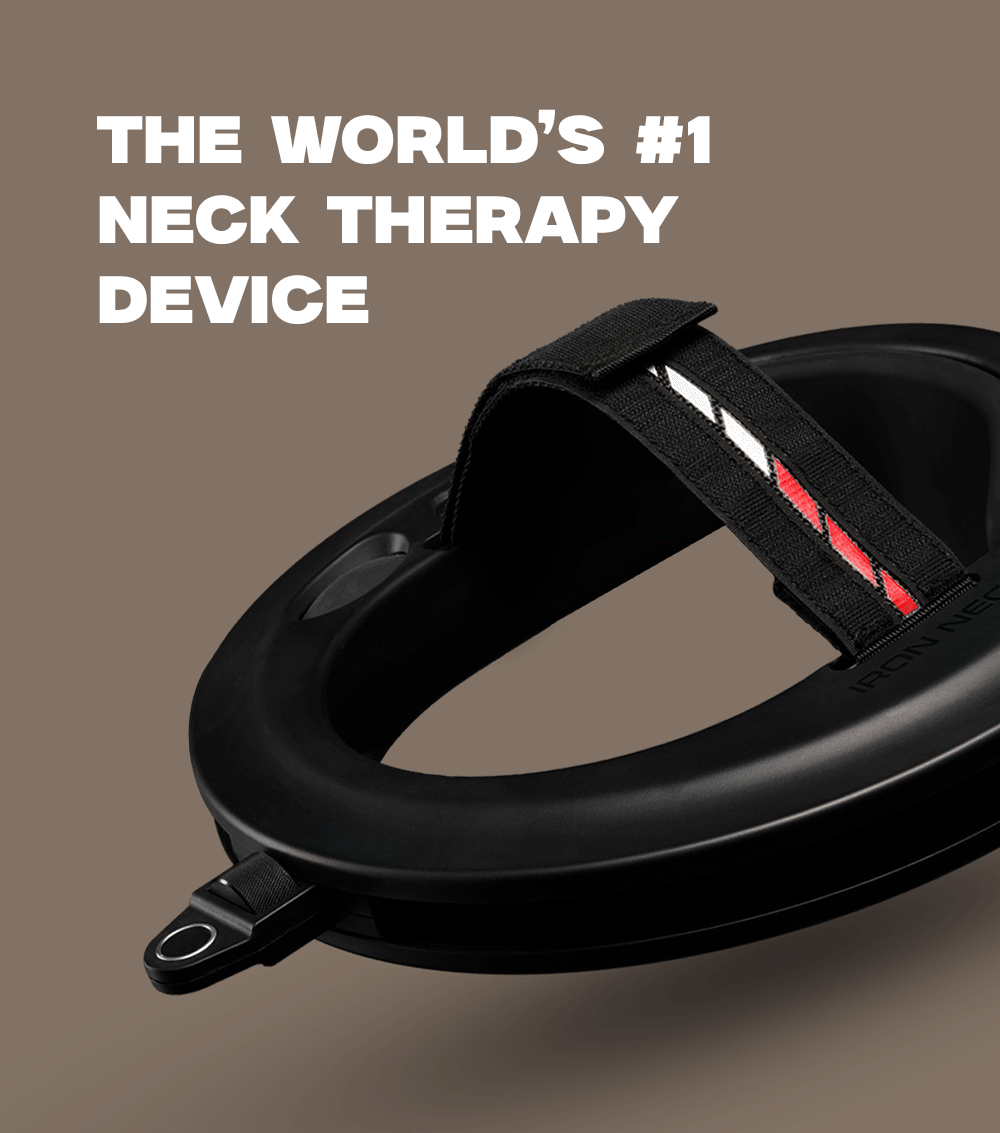
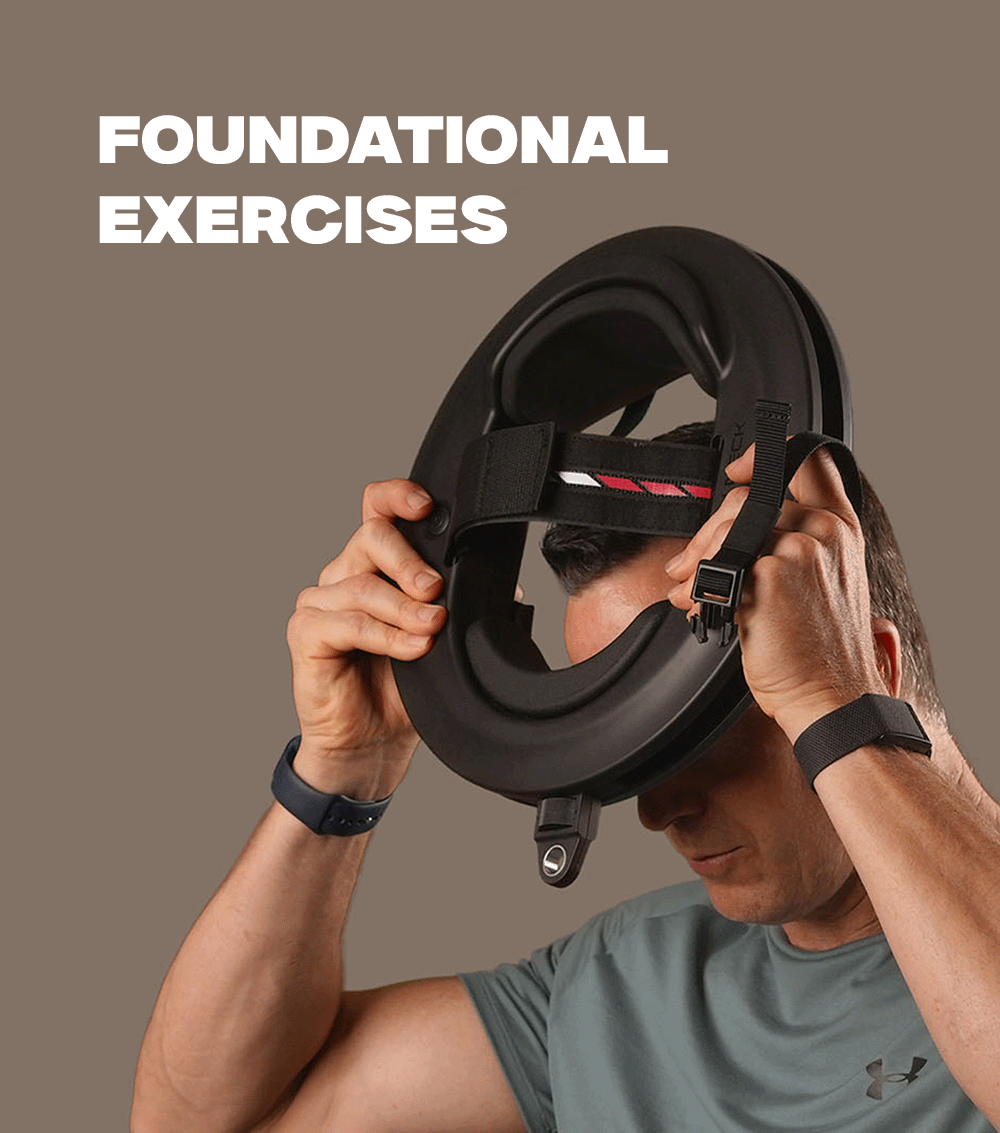
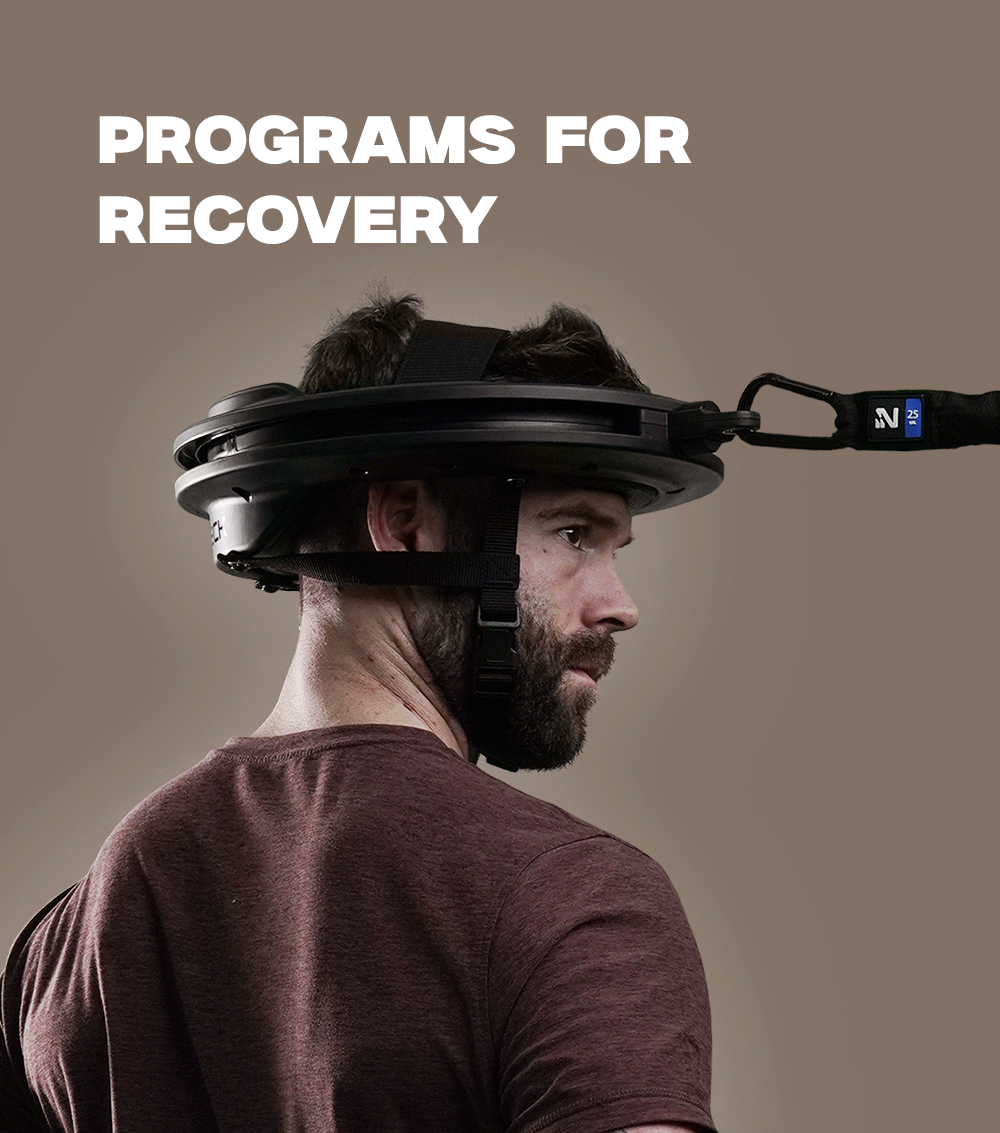
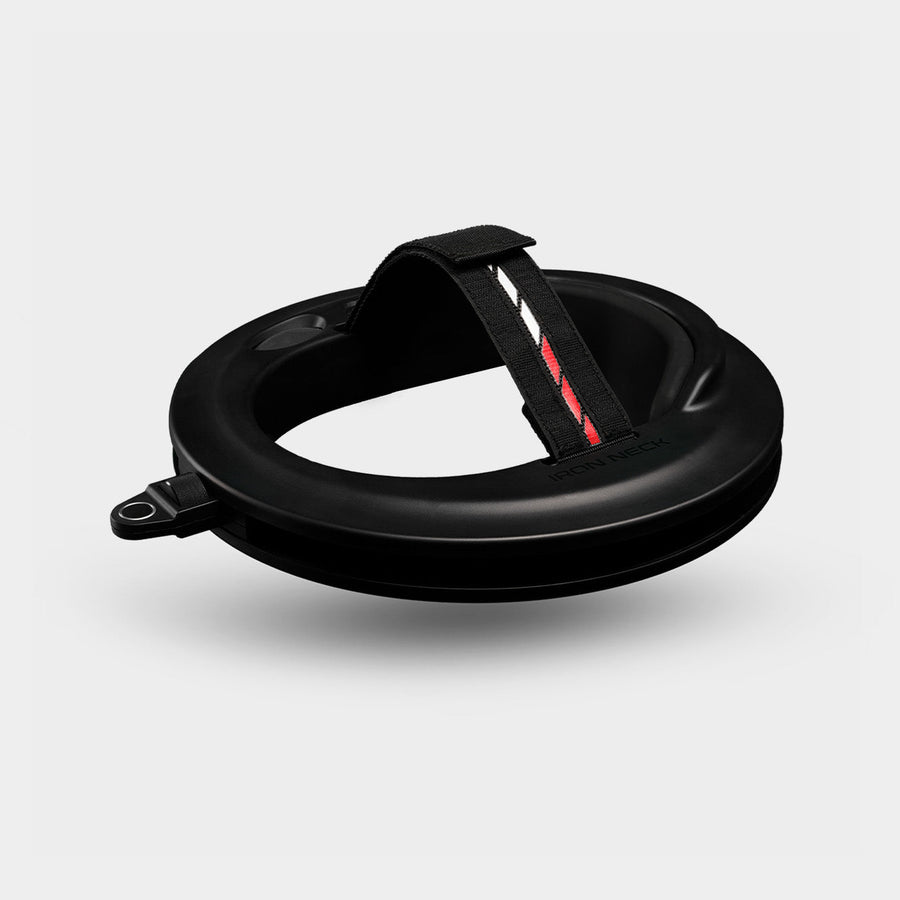
Train this program with the Iron Neck 3.0 Pro

The 360 degree resistance head unit this program is built around, with the anchor and bands you need to train every direction from day one.

Iron Neck 3.0 Pro
Iron Neck 3.0 Pro $599.00
Set your resistance

Light, medium, or heavy?

We call for an effort level instead of a specific weight, because the right resistance depends on you, the movement, and where you are in your training. For the sets and reps listed on each exercise, pick the resistance that makes the last few reps feel like the level shown.

Light

You finish the set with several clean reps still in the tank. The work stays easy and fully controlled from the first rep to the last.

Medium

You could manage a few more reps at the end, but not many. The final reps take real effort while your form holds.

Heavy

You reach the last prescribed rep with little or nothing left. Completing every rep with good form is genuinely hard.

These are starting points, not rules. Everyone is built differently, so adjust to fit you: size down if your form breaks before the final rep or a movement aggravates a symptom, and only size up once every rep feels smooth and pain free. When you are unsure, choose the lighter option.