


Sport Specific · Program 69

Quarterback Throwing Arm

For the arm speed and arm care a football thrower needs. It cares for the arm with gentle and full external rotations, face pulls, and overhead reaches, then builds the chain with Y-pulls, serve and throw simulation, rows, and lat pulls. The finish delivers deep-ball power with low-to-high diagonal power, rotational power throws, power pull-downs, and the TWYs combo.

Focus · Football / throwingFrequency · 3-4 days / weekSession · 15-25 min
Quarterback Throwing Arm cover art

Phase 1 · Care for the Arm

Care for the throwing arm. Gentle and full external rotations, face pulls, and overhead reaches build the cuff and rear shoulder that protect the arm. Arm care first is what keeps a hard throw from wearing the shoulder down.

01

Gentle External Rotations (Uncrossed)

2-3 sets of 12-15 reps (per side)Low Anchor

Universal recovery exercise with light external rotation. Promotes blood flow and gentle activation.

How To
1Perform gentle external rotation with very light resistance.
2Focus on blood flow, mobility, and gentle activation.
Coaching Cues
Very light resistance
focus on mobility
gentle movements
promote blood flow and recovery
Muscles Activated
External Rotators
02

External Rotation Series

3 sets of 12-15 reps (per side)Mid Anchor

Comprehensive external rotation training at multiple angles. Excellent for endurance and rotator cuff health.

How To
1Perform external rotation at different arm angles (0, 45, 90 degrees).
2Focus on endurance and varied positions.
Coaching Cues
Vary arm angles
slow controlled tempo
focus on endurance
maintain form throughout series
Muscles Activated
Posterior DeltoidInfraspinatusTeres MinorExternal Rotators
03

Face Pulls

3 sets of 12-15 repsHigh Anchor

Premier corrective exercise for the upper back and shoulder complex. Combines scapular retraction with shoulder external rotation to heavily target the posterior deltoids, infraspinatus, teres minor, and mid-to-lower trapezius. Vital for reversing rounded shoulder posture and building rotator cuff resilience.

How To
1Stand facing away from the high anchor point with a narrow stance.
2Begin with arms fully extended forward at shoulder height, holding the resistance bands with a neutral or slightly overhand grip.
3Pull the hands back toward the face by flaring the elbows out to the sides.
4Finish by pulling the hands completely back past the ears while keeping the elbows high and bent at a 90 degree angle, achieving full external rotation at the peak contraction.
5Mindfully extend the arms back to the starting position.
Coaching Cues
Keep the elbows high and aligned with the shoulders throughout the pull
focus on pulling the hands apart as they approach your ears
squeeze the shoulder blades tightly together at peak contraction
avoid shrugging the shoulders up toward the neck
maintain a strong braced core to prevent the lower back from arching.
Muscles Activated
04

Overhead Reaches (Uncrossed)

2 sets of 12-15 repsHigh Anchor

Promotes overhead mobility and activation. Excellent for swimming and overhead mobility restoration.

How To
1Reach arms fully overhead against light resistance.
2Focus on full extension and overhead mobility restoration.
Coaching Cues
Full overhead reach
emphasize shoulder elevation
gentle stretch feel
promote mobility
Muscles Activated
Anterior DeltoidLatissimus DorsiSerratus Anterior

Phase 2 · Build the Chain

Build the throwing chain. Y-pulls, serve and throw simulation, rows, and lat pulls strengthen the lats and scapular drivers that feed arm speed. A strong chain is what turns cuff health into a stronger throw.

01

Y-Pulls (Uncrossed)

3 sets of 10-12 repsLow Anchor

Activates lower trap and serratus anterior. Critical for scapular upward rotation and overhead function.

How To
1Stand facing low anchor, arms at sides.
2Pull bands up and out forming a Y shape overhead.
3Focus on lifting through shoulder blades.
Coaching Cues
Initiate movement from shoulder blades
keep arms straight
reach tall at top position
control the descent
Muscles Activated
Posterior DeltoidLower TrapeziusSerratus Anterior
02

Y Shape Pulls

3 sets of 10-12 repsMid Anchor

Lower trapezius dominant exercise crucial for scapular upward rotation and depression. Addresses scapular dyskinesis and prepares shoulders for overhead function. Essential for overhead athletes, swimmers, and anyone with shoulder impingement concerns.

How To
1Stand facing mid-level anchor, arms extended forward and up at approximately 45 degree angle forming letter Y shape overhead.
2Pull bands back and down, emphasizing scapular depression and retraction.
3Focus on engaging lower trapezius to pull shoulder blades down and together.
4Return with control.
Coaching Cues
Maintain Y angle throughout
initiate movement from shoulder blades
focus on downward pull of scapulae
reach tall at start of each rep
avoid excessive arm bend
control descent
think pull shoulder blades into back pockets.
Muscles Activated
Posterior DeltoidLower TrapeziusSerratus AnteriorScapular Stabilizers
03

Serve/Throw Motion Simulation (Crossed)

4 sets of 6-8 reps, explosiveMid Anchor

Sport-specific movement patterns. Excellent for tennis, volleyball, and throwing sports preparation.

How To
1Simulate sport-specific serving or throwing motions with controlled resistance.
2Focus on proper mechanics and timing.
Coaching Cues
Slow controlled motion
emphasize proper mechanics
sport-specific patterns
quality over speed
Muscles Activated
Posterior DeltoidSerratus AnteriorExternal Rotators
04

Single Arm Rows (Alternating)

3 sets of 8-10 reps (per side)High Anchor

Unilateral pulling strength. Excellent for functional strength and imbalance correction.

How To
1Stand facing high anchor, one arm extended forward.
2Pull band to ribs with rowing motion.
3Alternate arms or single arm focus.
Coaching Cues
Pull elbow to ribs
squeeze shoulder blade
maintain athletic stance
control the return
Muscles Activated
Posterior DeltoidLatissimus DorsiRhomboids
05

Lat Pulls (Crossed)(partial hip hinge)

3 sets of 8-10 repsHigh Anchor

Activates lats for swimming and overhead athletics. Excellent for thoracic extension and lat engagement.

How To
1Stand facing high anchor, pull from high to low position activating lat muscles and promoting thoracic extension.
Coaching Cues
Emphasize lat engagement
pull elbows to ribs
promote thoracic extension
control movement
Muscles Activated
Posterior DeltoidLatissimus DorsiSerratus Anterior

Phase 3 · Deep-Ball Power

Build deep-ball power. Low-to-high diagonal power, rotational power throws, power pull-downs, the TWYs combo, and sport-specific patterns train the shoulder to whip the arm through. You finish throwing farther with an arm built to take it.

01

Low to High Diagonal Power (Uncrossed)

4 sets of 6-8 reps, explosiveLow Anchor

Functional diagonal patterns. Excellent for throwing sports and kinetic chain development.

How To
1Pull explosively from low to high in diagonal pattern.
2Use legs and core for power generation.
3Complete follow-through.
Coaching Cues
Use legs and core
explosive upward pull
complete follow-through
integrate whole body movement
Muscles Activated
Anterior DeltoidSerratus AnteriorCoreScapular Stabilizers
02

Rotational Power Throws (Alternating)

4 sets of 6-8 reps, explosiveMid Anchor

Maximum rotational power for sports. Develops core integration and striking/throwing power.

How To
1Rotate explosively alternating directions, simulating powerful rotational motions with maximum velocity.
2Focus on core engagement.
Coaching Cues
Maximum rotation speed
engage core
maintain balance
use whole body for power generation
Muscles Activated
Anterior DeltoidPosterior DeltoidCore
03

Power Pull-Downs (Crossed)

4 sets of 6-8 reps, explosiveHigh Anchor

Explosive pulling for sport performance. Builds lat strength and overhead pulling power.

How To
1Stand facing high anchor, arms overhead.
2Pull bands explosively down to chest level.
3Control return to start position.
Coaching Cues
Explosive pull down
control the return
engage core
squeeze lats at bottom position
Muscles Activated
Posterior DeltoidLatissimus DorsiCore
04

TWYs Combo (Crossed)

3 sets of 12-15 repsHigh Anchor

Comprehensive high anchor sequence incorporating T, W, and Y positions. The W adds external rotation component making this ideal for rotator cuff health. Most complete scapular and rotator cuff activation sequence. Excellent for swimmers, overhead athletes, and comprehensive shoulder health programs.

How To
1Stand facing high anchor with crossed bands.
2Begin with T position (arms out at shoulder height), pull down and back.
3Transition to W position (elbows bent to 90 degrees at shoulder height, forearms vertical), pull down and back emphasizing external rotation.
4Finish with Y position (arms overhead at 45 degrees), pull down and back.
5Perform as continuous sequence.
Coaching Cues
Control all three positions with precision
emphasize external rotation in W position
strong scapular retraction in T position
scapular depression in Y position
smooth transitions
maintain alignment
breathe rhythmically throughout entire sequence.
Muscles Activated
Posterior DeltoidLatissimus DorsiRhomboidsMiddle TrapeziusLower TrapeziusSerratus AnteriorInfraspinatusExternal RotatorsScapular Stabilizers
05

Sport-Specific Patterns (Uncrossed) (single)

4 sets of 6-8 reps, explosiveLow Anchor

Adaptable exercise for sport-specific movement patterns. Modify based on sport demands.

How To
1Perform sport-specific movement patterns with band resistance.
2Adapt to individual sport requirements and movement patterns.
Coaching Cues
Sport-specific mechanics
adapt to individual needs
control movement quality
progress intensity
Muscles Activated
Scapular Stabilizers
Get the gear

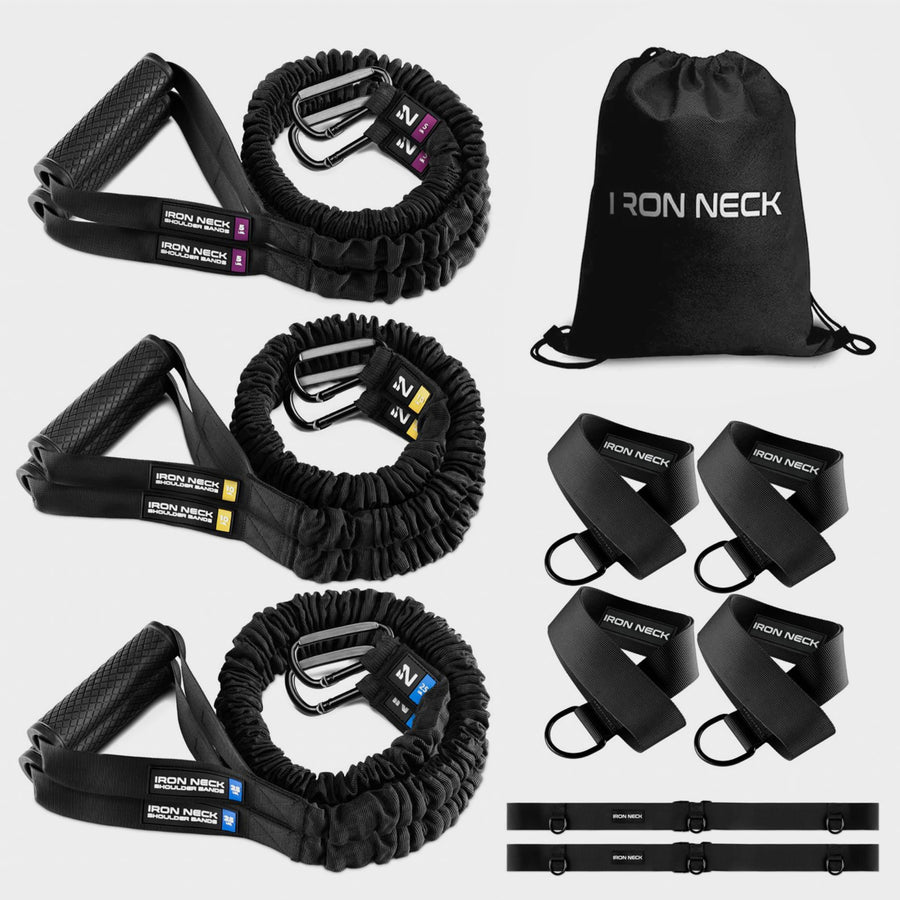
Train this program with Iron Neck shoulder bands

Cloth wrapped bands with graduated resistance and a door anchor for high, mid, and low setups. Everything this program calls for, in one kit.

Prehab and Performance Shoulder Bands (Set of 6)
Prehab and Performance Shoulder Bands (Set of 6) $199.00
Set your resistance

Light, medium, or heavy?

We call for an effort level instead of a specific weight, because the right resistance depends on you, the movement, and where you are in your training. For the sets and reps listed on each exercise, pick the resistance that makes the last few reps feel like the level shown.

Light

You finish the set with several clean reps still in the tank. The work stays easy and fully controlled from the first rep to the last.

Medium

You could manage a few more reps at the end, but not many. The final reps take real effort while your form holds.

Heavy

You reach the last prescribed rep with little or nothing left. Completing every rep with good form is genuinely hard.

These are starting points, not rules. Everyone is built differently, so adjust to fit you: size down if your form breaks before the final rep or a movement aggravates a symptom, and only size up once every rep feels smooth and pain free. When you are unsure, choose the lighter option.