



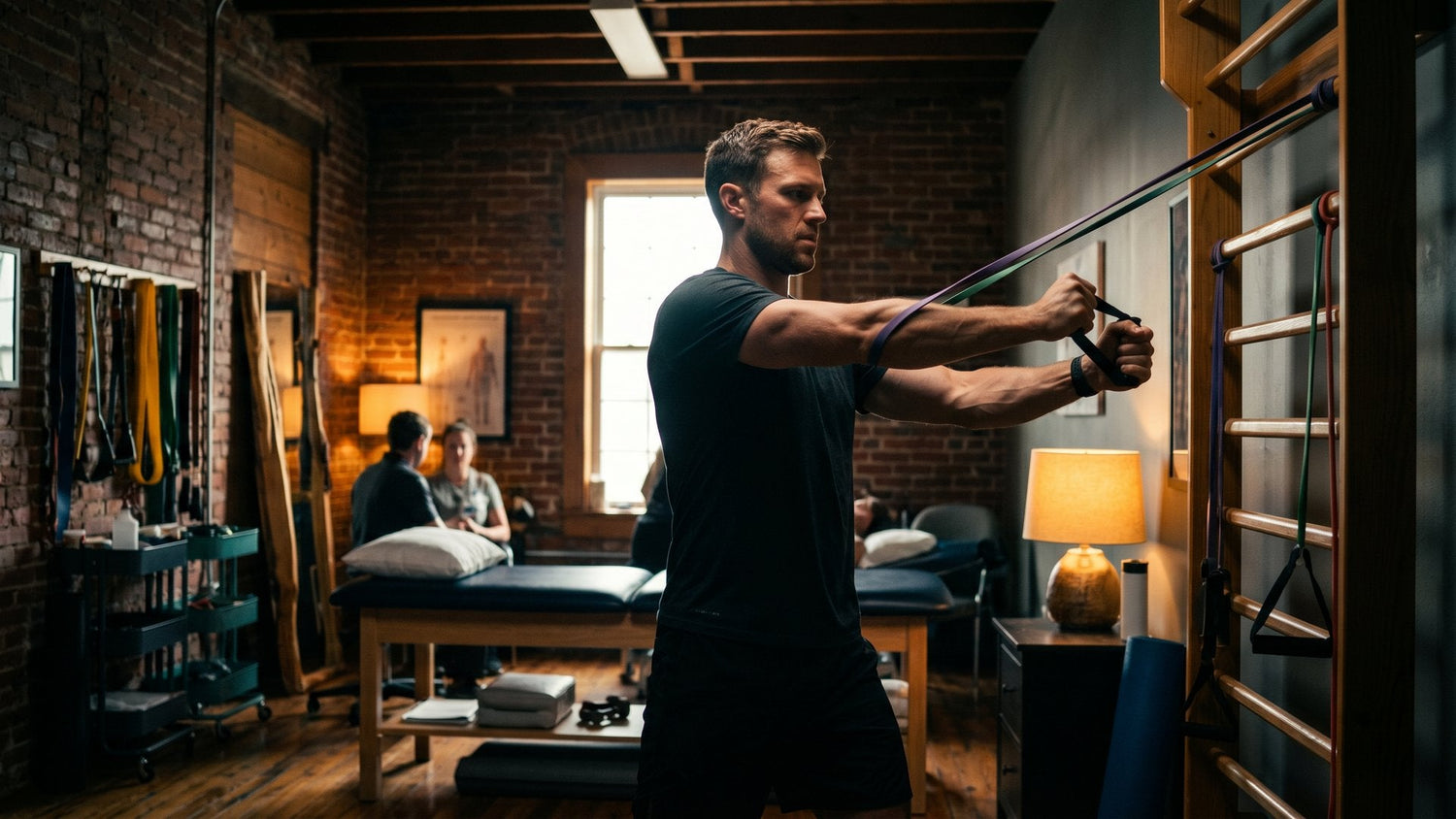
Shoulder Bursitis Exercises: Reduce Pain and Rebuild Strength
Shoulder bursitis is one of the most common causes of shoulder pain, yet it is frequently misunderstood and mistreated. The subacromial bursa, a fluid-filled sac that sits between the rotator cuff tendons and the acromion, becomes inflamed when it is repeatedly compressed or irritated. The result is a deep, aching pain that is typically worse with overhead movements, lying on the affected shoulder, and reaching across the body. The good news is that most cases of shoulder bursitis respond well to a structured exercise program that reduces the mechanical compression on the bursa while rebuilding the strength needed to prevent recurrence.
Understanding Shoulder Bursitis
The subacromial bursa exists to reduce friction between the rotator cuff tendons and the bony acromion during shoulder movement. When the bursa becomes inflamed, either from acute trauma, repetitive overhead activity, or the gradual compression that accompanies rotator cuff weakness and poor scapular control, it swells and becomes painful. The swelling itself further reduces the subacromial space, creating a cycle of compression and inflammation that can be difficult to break without targeted intervention.
The most effective long-term treatment for shoulder bursitis is not rest or anti-inflammatory medication alone, though both may be appropriate in the acute phase. It is the correction of the underlying mechanical factors that caused the bursa to become compressed in the first place. These factors almost always include some combination of rotator cuff weakness, poor scapular upward rotation, posterior shoulder capsule tightness, and thoracic stiffness. Addressing these factors through exercise is the key to both resolving the current episode and preventing future recurrence.
Acute Phase Management (First 2 to 3 Weeks)
During the acute phase, when pain and inflammation are at their peak, the priority is reducing the mechanical load on the inflamed bursa while maintaining gentle movement to prevent stiffness.
Activity Modification: Avoid overhead activities, heavy lifting, and any movement that reproduces your pain. This does not mean complete rest; gentle, pain-free movement is beneficial and should be maintained throughout the acute phase.
Pendulum Exercises: Stand beside a table and lean forward, supporting your weight with your unaffected arm. Allow your affected arm to hang freely. Gently swing the arm in small circles, forward and backward, and side to side. Perform for 2 minutes, two to three times daily. Pendulum exercises maintain joint mobility without compressing the subacromial space.
Scapular Retraction: Sit or stand upright. Squeeze your shoulder blades together and down. Hold for 5 seconds and release. Perform 3 sets of 15 repetitions. This exercise activates the lower and mid trapezius and begins to improve scapular positioning without loading the subacromial space.
Strengthening Phase (Weeks 3 to 8)
As acute pain subsides, the focus shifts to progressive strengthening of the rotator cuff and scapular stabilizers. These exercises reduce the compression on the subacromial bursa by improving the mechanical efficiency of shoulder movement and restoring proper humeral head positioning during arm elevation.
Band External Rotation: Attach a resistance band to a fixed point at elbow height. Stand sideways to the band with your affected arm closest to the anchor. Hold the band with your affected hand, elbow bent to 90 degrees and pressed against your side. Rotate your forearm outward against the resistance. Return slowly. Perform 3 sets of 15 repetitions. External rotation strength is the most important factor in reducing subacromial compression during arm elevation. The Iron Neck resistance bands are ideal for this exercise, with multiple resistance levels that allow progressive loading.
Band Face Pulls: Attach a resistance band at face height. Pull the band toward your face while simultaneously externally rotating your shoulders. Squeeze your shoulder blades together and down at the end of the movement. Perform 3 sets of 15 repetitions. Face pulls train external rotation and scapular retraction simultaneously, making them highly efficient for shoulder bursitis rehabilitation.
Prone Y-T-W Raises: Lie face down with your arms extended overhead in a Y position. Lift your arms off the floor by squeezing your lower trapezius. Hold for 2 seconds and lower. Move your arms to a T position and repeat. Then bend your elbows to 90 degrees in a W position and repeat. Perform 2 sets of 10 repetitions in each position. This exercise trains the lower and mid trapezius, which are essential for proper scapular upward rotation during arm elevation.
Side-Lying External Rotation: Lie on your unaffected side with your affected arm on top, elbow bent to 90 degrees. Hold a light dumbbell (2 to 5 pounds). Rotate your forearm upward until it is perpendicular to the floor. Return slowly. Perform 3 sets of 15 repetitions.
Stretches to Include Throughout Recovery
Posterior shoulder capsule tightness is a common contributing factor to shoulder bursitis, as it causes the humeral head to migrate anteriorly and superiorly during arm elevation, reducing the subacromial space. The cross-body stretch addresses this: bring your affected arm across your chest and use your opposite hand to gently pull it closer to your body. Hold for 30 seconds. Perform three times daily.
Thoracic extension mobility is equally important. A stiff, rounded thoracic spine limits the upward rotation of the shoulder blade, which reduces the subacromial space during arm elevation. Perform foam roller thoracic extension daily to maintain thoracic mobility.
Returning to Overhead Activities
Overhead activities should be reintroduced gradually and only after you have achieved full pain-free range of motion and adequate rotator cuff strength. Begin with light overhead reaching and progress to more demanding overhead activities over several weeks. If pain returns with overhead activity, reduce the load and range of motion and consult your physical therapist.
When to See a Doctor
Consult a physician if your pain is severe or worsening despite conservative management, if you have significant weakness or loss of motion, if you have not seen improvement after six to eight weeks of consistent exercise, or if you have a fever or redness around the shoulder. These presentations may indicate a more serious condition, such as a rotator cuff tear, septic bursitis, or calcific tendinopathy, that requires medical evaluation and potentially imaging.


Leave a comment
This site is protected by hCaptcha and the hCaptcha Privacy Policy and Terms of Service apply.